Archive

Archive for October, 2010

Techyum Halloween: The Ruger 10/22 Fun Gun For Authentic Gangster Action

October 31st, 2010 No comments
Ruger 10/22 Fun Gun-Thompson Conversion Kit image courtesy of 1022FunGun.com

Ruger 10/22 Fun Gun-Thompson Conversion Kit image courtesy of 1022FunGun.com

Have you ever said to yourself, “You know, I love my Ruger 10/22, but how can I take it to the next level of fun?”

I think we’ve all asked ourselves that question.

When it’s time for the answer, ring up the wild and crazy guys at 1022FunGun.com, who know that “Fun” means a trip back to the laugh-a-minute days of the bloody St. Valentine’s Day Massacre, the party atmosphere of Okinawa and the swingin’ times of Anzio.

That’s right, 1022FunGun.com is where you can guy a conversion kit to give your Halloween costume the ultimate air of authenticity: a Ruger 10/22 that looks just like a Thompson submachinegun but fires inexpensive .22 LR ammo, eliminating the annoying skyward barrel creep the Thompson is known for and making it much cheaper to shoot just for laughs. Can you imagine the green Al Capone would have saved on that day in 1929 if his men had pumped out 70 rounds of .22 LR (about 5 cents a round in today’s market) instead of .45 ACP (closer to $1 a round).

More importantly, can you imagine the looks on the faces of your friends down on Castro and Market when a pigeon crosses the street and you haul this mother out from under your trench?

Made of aluminum, steel, and American walnut, the Fun Gun Kit requires no machining and no trip to the gunsmith. Plus, since some Thompsons originally came with 50-round drums in the heady days of blowing away cattle rustlers with this puppy, if you order the Fun Gun Kit with the 50-round drum magazine, the late Senator Edward Kennedy will personally rise from the grave and deliver it to your front door with a signed statement that he’s really sorry he helped ban high-capacity magazines in 1994,  and he understands now that freedom comes from the barrel of a Thompson replica, especially for zombies.

Actually, I made that last part up; not just the magazine ban apology and the zombies — the whole thing. Ted Kennedy won’t rise from the grave, and the federal assault weapons ban expired in 2004. However, the 50-round drum that comes with the “Chicago” rendition of the Fun Gun kit is a dummy, as is the 20-round magazine that comes with the (far more common in its day in the actual Thompson) “Squad Leader” configuration. Needless to say, the weapon continues to shoot like a regular 10/22, with a patented, detachable 10-shot rotary magazine.

Here are the two other configurations of the converted Ruger 10/22:

Ruger 10/22 from 1022FunGun.com

With dummy 50-round drum magazine

Ruger 10/22-Thompson Fun Gun Kit image courtesy of 1022 FunGun.com.

"Pistol" kit converted Ruger 10/22.

"Want some candy, Adolph?" Smart-looking British guy showing off HIS Halloween costume, 1940.

Tags: ,

ZomBcon Slays the Latte Zombies

October 30th, 2010 No comments

Kids!! Learn important skills for the job market of tomorrow at ZomBcon!

Up in the land of the rain-soaked latte zombies they’re contending with the real kind. I’m referring, of course, to ZomBcon, an orgy of zombified weirdness sure to satisfy even the most survival-minded horror fan that continues through tomorrow. Events at this one-stop-shop for rotting corpses with bad attitudes don’t just include your garden-variety “meet the B-movie actor” sign-and-shakes with the likes of George Romero, Bruce Campbell and World War Z‘s Max Brooks and discussions about whether chainsaws or flame throwers are preferable. No, that kind of crap may work for the drawing-room crowd; it may play in Edinburgh or Cincinnati, but these Northwest cats are multi-media — and the media are your BRAINZ. There’s a “Zombie Mass Renewal of Vows” for loving couples seeking to put some life back in their marriage. There’s “Zombie Cage Fighting,” hosted by UFC. There was even a zombie prom last night, and where else could you celebrate Hello Kitty’s 50th birthday?

The answer, of course, is none. None more else. That is to say, none more else but ZomBcon.

Tags: ,

Take a Trip to Zombie School

October 30th, 2010 No comments

For those who eschew the theoretical, abstract, ivory tower intellectualism of college classes about zombies, there’s always the trade school option, right?

The above video should help you bone up on your lumbering. It’s about the “zombie school” held for 150 extras in AMC’s The Living Dead, which (in case you’ve been living in a bunker) premieres on Halloween, and includes an interview with “Zombie Choreographer” Matt Kent. Wouldn’t I love to have his business cards?

Terry Morrow of the Knoxville News-Sentinel relates the experiences of Knoxville, Tennessee resident Linds Edwards in attending said zombie school, with some quotes from the show’s makeup supervisor, Greg Nicotero. Apparently there are a lot of rules — no dragging your feet, and no keeping one arm crooked. That’s strictly Ed Wood crap, it seems.  Morrow quotes Nicotero:

“There has to be a disconnect between your mind and what your body wants to do,” he says. “You have to think then move.”

He wanted extras to hang outside bars at 2 a.m. to see patrons leave. “They think they are perfectly OK when they walk,” he says of the patrons, “but they aren’t.”

…”There’s a subtle art to being a zombie,” he says. “If you do too much and are over the top, you aren’t a zombie anymore.

“You’re a person trying to act like a zombie.”

[Link.]

Let me tell you, when I leave a bar at 2 a.m., I’m a person trying  not to act like a zombie.

“The Living Dead” (in case you’ve been hiding out in a nice cozy grave) has been receiving a serious marketing blitz in recent days, including a 26-city zombie walk. The show is based on a graphic novel series of the same name now available for purchase at bookstores, truck stops and 7-11s near you.

Tags: , ,

Counter Space: Design and the Modern Kitchen

October 28th, 2010 No comments

Margarete Schütte-Lihotzky (Austrian, 1897-2000). Frankfurt Kitchen from the Ginnheim-Höhenblick Housing Estate, Frankfurt am Main, Germany (reconstruction). 1926–27. Various materials, 8’9” x 12’10” x 6’10” (266.7 x 391.2 x 208.3 cm). The Museum of Modern Art, New York. Gift of Joan R. Brewster in memory of her Husband George W.W. Brewster, by exchange and the Architecture & Design Purchase Fund. Image courtesy of MoMA.

Counter Space: The Evolution of the Kitchen, running at New York’s Museum of Modern Art through March 2011, chronicles the rise of the kitchen as a defining possession of the twentieth-century Western middle class.

Starting with the iconic post-World-War-I German concept of Grete Schütte-Lihotzky’s “Frankfurt Kitchen,” which “reflected a commitment to transforming the lives of ordinary people on an ambitious scale,” the exhibit shows how kitchens a central part of what defines domesticity:

Previously hidden from view in a basement or annex, the kitchen became a bridgehead of modern thinking in the domestic sphere—a testing ground for new materials, technologies, and power sources, and a spring board for the rational reorganization of space and domestic labor within the home…kitchens have continued to articulate, and at times actively challenge, our relationship to the food we eat, popular attitudes toward the domestic role of women, family life, consumerism, and even political ideology in the case of the celebrated 1959 “Kitchen Debate” that took place between Richard Nixon and Nikita Khrushchev in Moscow at the height of the Cold War.

Featured alongside the Frankfurt Kitchen is a 1969 mobile fold-out unit manufactured by the Italian company Snaidero. These two complete kitchens are complemented by a wide variety of design objects, architectural plans, posters, archival photographs, and selected artworks, all drawn from MoMA’s collection. Prominence is given to the contribution of women throughout the exhibition, not only as the primary consumers and users of the domestic kitchen, but also as reformers, architects, designers, and as artists who have critically addressed kitchen culture and myths.

The exhibit is presented in conjunction with this past summer’s hardcover Modern Women: Women Artists at The Museum of Modern Art. The New York Times and NPR both have interesting reviews of the exhibit.

Counter Space: Design and the Modern Kitchen runs through March 14, 2011 in the Michael H. Dunn Gallery on the second floor of the Museum of Modern Art, 11 West 53rd Street, New York City.

Tags: , ,

Mind-Controlled Sex Slaves and the CIA

October 27th, 2010 1 comment

Every once in a while I run across a book that makes me think, “This world. It’s a big one. And there are some really unusual people in it.”

I know!!! “Define unusual!!!” I had the very same thought.

I have no idea what’s in Mind-Controlled Sex Slaves of the CIA, other than — presumably — that it involves mind-controlled sex slaves and the CIA. A responsible journalist (say, Hunter S. Thompson in one of his braver moods) would probably buy it for his Kindle, read it and hand the pieces of his detonated brain over to you, the Techyum reader, maybe with a hand-scrawled Post-It note saying: “Ow. Do not read. –HST.”

But Thompson was defining an era with his bold new vision of gonzo journalism. At Techyum, we’re pretty  much just treading water until the dead start to rise and we finally get to whack monsters with very large handguns and not feel all that bad about it.

Besides, the blurb and cover themselves provide as much newsworthiness as a Republican Congressman copping a squirt in a rest stop in rural Idaho…wearing his wife’s prom dress. Read more…

British Team To Search for the Mande Barung in Northern India

October 27th, 2010 No comments

Creative Commons photo by Wayne Parrack of Bigfoot carving in central Washington state, sculptor unidentified.

The Mande Barung (sometimes spelled Mande Burung or Mande-burung) is an apelike creature thought to reside in the tropical rainforests of the Garo Hills, which straddle Northeast India and western Bangladesh. It’s thought to be related to the Tibetan Yeti, the Chinese Yeren, the Almas of Mongolia and the Caucasus, the Bigfoot or Sasquatch of North America’s Pacific Northwest, and by extension the Skunk Ape of Florida.

Bangladesh, incidentally, has to contend with not only the Mande Barung, but a second pesky cryptohominid, pretty impressive for a country of its size. I speak, of course, of the Ban-manush or Nyalmo, about which, in case you were wondering, Wikipedia offers this convincing argument for the stark-raving-madness of crowdsourcing anything more complex than standing there looking confused.

But…what was I saying about the Mande-Barung? Ah, yes: A post on Mania.com by Nick Redfern (about whom more anon) informs me that a British team departing October 31, 2010 will begin a methodical search for the Mande Barung in the India part of the Garo Hills. The team is supported by the Center for Fortean Zoology (CFZ). A few pertinent deets from Mr. Redfern:

The 5-man team will be led by Adam Davies – the author of the monster-hunting-themed book, Extreme Expeditions – and will also consist of Dr Chris Clark, Dave Archer, field naturalist John McGowan, and cryptozoologist Richard Freeman; the latter a former keeper at England’s Twycross Zoo and the author of the book, Dragons: More Than A Myth.

Jonathan Downes, the founder and director of the , says of these strange and elusive animals: “The creatures are described as being up to ten feet tall, with predominantly black hair. Most importantly, they are said to walk upright, like a man. Walking apes have been reported in the area for many years. These descriptions sound almost identical to those reported in neighboring Bhutan and Tibet. Witnesses report that the Mande-Burung – which translates as forest man – is most often seen in the area in November.”

Read more…

Tags: , ,

NYC’s Subway Art History Collective

October 26th, 2010 No comments

Image via Streetsy.

The New York Times has a great article today on the Subway Art History project by a collective called Slavery that recreates some of NYC’s classic graffiti with a modern twist — like “Joan of Arc” image here, a recreation of a famous subway painting, “Hand of Doom,” that you can see in the accompanying Times photo gallery.

[They are] the works of a newly formed collective of (mostly) former graffiti writers in their 20s and 30s, who have embarked on an unusual citywide campaign to summon 50 or more of the most famous pieces of old-school graffiti out of the history books and back onto the streets. The project, called “Subway Art History,” is unusual not only because the artists are making the pieces with the permission of businesses, schools and other perhaps nostalgic owners of blank vertical space, but also because of the nature of the pieces themselves. They are expressions of homage in a subculture that has almost always been defined by fierce competition, intense striving for originality and a kill-the-elders attitude toward the past.

…In New York the idea is to use the pieces to try to teach a two-part history lesson. The first is about the glories (as the collective sees it) of the early days of graffiti and the invention of a vernacular art form that has swept the world. The second lesson is about world history itself, in neighborhoods where education remains low on the list of priorities for many struggling teenagers.

[Link to NYT Article]

[Link to NYT Photo Gallery]

[via Streetsy]

Giant Viruses Devour the World’s Oceans Just in Time for Halloween

October 26th, 2010 4 comments

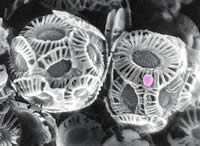
Coccolithovirus, which has about 400,000 base pairs. Public Domain image from Wikipedia.

An article in The Scientist discusses the earthshaking changes in the world of virus genomes. Seriously! Giant viruses. Who knew it was gonna be such an exciting Halloween!

The big news is not (just) the size of the virus itself, but the number of base pairs in its genome. (Number of base pairs is how you measure the size of a genome, apparently). Most viruses carry their genetic material in DNA form; a virus with RNA is a retrovirus (retroviruses are less common and tend to have fewer base pairs). While humans have about 3.2 billion base pairs, the first DNA virus to be completely sequenced, Phi X 174, has only about 5,400 bases.

But now researchers reporting in The Proceedings of the National Academy of Sciences have discovered a giant marine virus with 700,000 base pairs. It’s the first giant virus discovered in a marine organism, as The Scientist reports:

Over the past decade or so, scientists have slowly begun identifying viruses that defied the conventional idea that they were tiny infectious agents with highly streamlined genomes.

In 2004, researchers discovered and sequenced the 1.2 million-base pair genome of the largest known virus to date, the mimivirus (although still dwarfed by sequenced multicellular organisms, whose genomes usually exceed 100 million base pairs)…

…The new giant virus, dubbed CroV, is the first to be isolated from a marine organism — a microzooplankton called Cafeteria roenbergensis. They are major consumers of heterotrophic bacteria and phytoplankton, and thus critical to maintaining the delicate balance of marine food webs.

Once thought not to exist in marine environments, scientists now realize that there are some 50 million viruses in every milliliter of seawater. Every day, marine viruses kill about 20 percent of the ocean’s microorganisms, which produce about half the oxygen on the planet.

[Link.]

Microbiologist James Van Etten said of the giant viruses currently devouring the world’s oceans:  “There are likely many more; it’s just a matter of people looking.”

…but not behind you.

Whatever you do, don’t look behind you!

Why College No Longer Blows: Television and Brrrrrrrrrrraaaaaaaaaaaaiiiiiiiiiinnnnnnssss

October 25th, 2010 2 comments

Creative Commons Photo by Jackie Kingsbury.

There’s a story by Debra Levi Holtz in today’s SF Chronicle about a new course at UC Berkeley that analyzes AMC’s Mad Men. As Holtz puts it:

The class is part of UC Berkeley’s DeCal program, a student-run education undertaking that allows students to create and facilitate their own classes on a variety of often unconventional subjects. Considered a unique and “democratic” aspect of Berkeley’s undergraduate program, the program offers 150 courses each semester for up to two units of academic credit on topics that range from Harry Potter and “Sex and the City” to numismatics and swing dance.

For what it’s worth, I was a guest lecturer at DeCal classes at UC Berkeley several times over the years. I think this stuff rocks. But the article makes kind of a lot out of the “unusual” idea:

During the weekly class, the TV show is given the treatment normally reserved for works of literature. Words like “archetype” and “tragic” pop up frequently as students analyze Mad Men’s glamorous yet troubled characters. The class explores the politics and culture of the early ’60s and discusses themes such as the role of women in the workplace, class and society, marriage and family.

…which tells me that Levi has never talked about Scarface with coke-addled screenwriters or hung out talking Firefly with pseudo-intellectual science fiction geeks, or guys writing zombie apocalypse novels based on Lysistrata.

American Studies professors and people who smoke weed have been tearing pop literature and television apart for decades, doing wacky things like comparing Forbidden Planet to The Tempest and Star Trek episodes to Shelley’s Adonaïs — somebody stop them! They’re going cuh-raaaaayyyyzeeee!

Just how vast a No Man’s Land between literature and entertainment does the mainstream media think there is? Let’s not act like we’re reinventing the wheel here, shall we?

To my way of thinking, this stuff is a positive trend, but the fact that mainstream sources keep reporting that college courses deconstructing pop culture properties are somehow suspect — and need to be justified through extensive rationalization — makes me worry that the people who write newspaper articles believe what they see on TV neither has subtext nor is worthy of assault from a critical view.

Do people who write for the media actually believe what they see in the media?

And that, my friends, is a terrifying thought.

Oh, but did somebody mention zombies a minute ago? Yeah, funny they should come up around Casa Techyum, ’cause, like, that never happens. Did you know Professor Arnold Blumberg is teaching a zombie class in the Literature department this semester at the University of Baltimore? No shit!!!!  Now THAT sumbitch gets a Techyum high-cinco, not so much for teaching a zombie class as for bringing a severed head to class on the first day, an event the Baltimore Sun regales us with:

Arnold Blumberg plops the zombie head on a table at the front of the small theater.

“I brought a friend,” says the University of Baltimore professor, clad in an unbuttoned black shirt adorned with red skulls.

Blumberg is meeting his class for the first time and it seems appropriate that he greet them beside “old Worm Eye,” undead star of the 1979 Italian cult film “Zombi 2.”

It turns out he’s not just your garden-variety lit professor who teaches a zombie class. He’s a garden-variety lit professor who teaches a zombie class, wrote a book about zombies and a series of Dr. Who fan merchandise guides, and while we’re at it who blogs about science fiction, monster movies, and the politics of the word “geek” at his ATBPublishing blog.

The Baltimore zombie class got Prof. Blumberg coverage in the BBC, the Washington Post (who topped their article with the 28 Days Later trailer), CNET (which headlined theirs “Zombies to fill brains…” — DOH!!), and MSNBC (whose article mentions Georgetown’s internet-famous “The Philosophy of Star Trek” course and MIT’s “American Pro Wrestling” and soap opera courses) — among many others.

As mentioned, Blumberg’s class is taught in the literature department, but was at least partially inspired by the University of Baltimore’s new Pop-Culture minor.

Needless to say, government security around Baltimore has been tight since Blumberg’s class started. But a satellite-relay connection from Techyum offices deep in Cheyenne mountain to a Japanese surveillance satellite produced this photo of a few of the students lumbering out of Blumberg’s class:

Creative Commons satellite surveillance photo by David Kent, Flickr user Simple Pleasures.

…well, at least the crisis has helped them find Jesus.

Seriously, this is a wave sweeping the intellectual life of our nation faster than pink underwear! Don’t delay!!! Act now!!! Prepare, before these infectiously thought-provoking classes reach your institutional learning facility!!! Educate yourself, read up on the issue, and get your toys ready! Be sure to put out some decoys for the trigger-happy Freshmen, have your escape planned, and when midterms come please comply with all instructions from municipal authorities!

Tags: , ,

Robot Hand is a Balloon Filled With Coffee Grounds

October 25th, 2010 No comments

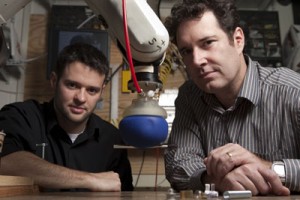
John Amend and Hod Lipson with the robot hand. Photo by Robert Barker, University Photography, via the Cornell Chronicle Online.

Fast Company’s Ariel Schwarz has a post about an amazing robot hand developed by researchers at Cornell, iRobot Corporation and the University of Chicago. It’s made out of what amounts to a balloon filled with coffee grounds.

You heard me! A balloon filled with coffee grounds. And it turns out that this particulate-matter sort of robot-hand concept is almost old hat in the robot-concept department, though this is a new application.

Before you start digging through your compost, read on. Schwarz describes this amazing concept with a quote from one of the designers:

Hod Lipson, Cornell associate professor of mechanical engineering and computer science, explained in a statement, “The ground coffee grains are like lots of small gears. When they are not pressed together they can roll over each other and flow. When they are pressed together just a little bit, the teeth interlock, and they become solid.” Any particulate matter that jams well can be used in theory; the researchers chose coffee after experimenting with ground-up tires, rice, and couscous.

Couscous. Is science delicious, or what?

Fast Company’s piece features a New Scientist video, and the Cornell Chronicle has more info about the robot hand’s development.

Furthermore, a Hizook post informs me that this type of technology is (or was) called “particle-jamming skin,” and nicknamed the “blob bot,” which I like a lot better.

A user comment on Schwarz’s post mentions that iRobot CEO Collin Angle demonstrated a prototype of this concept back in 2009 at TEDMED in a talk about robots for medical applications. It’s a talk filled with fascinating robot love:

Tags: , ,