Archive

Archive for March, 2011

Personal Cremation Urns for Stalkers and Weirdos

March 30th, 2011 1 comment

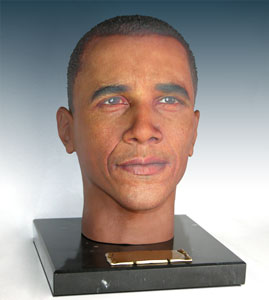
This makes my brain hurt. Cremation Solutions makes personalized urns for you to, you know, keep the cremated remains of your, you know, loved ones until you accidentally drink them thinking they’re chocolate milk or spill them all over the floor while being interviewed on TV.

And what’s the example Cremation Solutions decided to use? Inexplicably, they used someone who’s still alive. A sitting president, in fact. Say what?

If this is a hoax, it’s the best hoax ever. It is such a good hoax, in fact, that it takes F is for Fake, bends it over the Electric Cremated Remains Processor, and buggers it so hard Orson Welles is crying like a bitch inside his bust of himself. But if it’s real? Somebody needs therapy. Somebody needs lots and lots of therapy. And I think it’s me.

Oh, but what’s that you say? Your favorite president is Hilary Clinton, Margaret Thatcher or David Crosby? No, the hair won’t be a problem!


Personal urns can have hair added digitaly for short haired people, as in the sample of President Obama. For longer hair we can add a wig to your specifications.

You know who else “can add a wig to my specifications?” The RealDoll people. See what I’m getting at?

Or do you think putting hair on a chopped-off head made to hold human ashes keeps it from being at all creepy? Sure, my girlfriend would probably think it was creepy if I told her that if I’m ever dragged from the flaming wreckage of my Volkswagen, I’d like her to please ensure that I get “processed” and poured into the hacked-off head of someone I admire. Would that be cool?

“Gasp!!” she might say “You can’t mean — a BALD Neil Gaiman!!??!!”

“No way!” I’ll tell her. “Don’t be disgusting! I’ve been paying Amanda Palmer to raid his hairbrushes and Fed Ex me his hair. I’ll have a full wig by the time I kick off, don’t you worry. You’ll just have to take it off and shampoo it every six to eight weeks. Also brush it every day.”

So…that’s not creepy.

The idea, as I understand it, is that you, as the survivor, would create a 3-dimensional “sculpture” of your dead lover, parent, child, pet, or arch-enemy. You pour their ashes inside, and voila! You remember them always. Makes perfect sense, right?

But why Prez Obama? F is for Fuck If I Know!

I surmise that the hoped-for phenomenon, in the damaged minds of its conceivers, is not peculiar to Obama, he was just the first person they thought of. I guess the idea is, if your croaky-croaked loved one for some reason needs to kiss somebody’s ass even after being reduced to fucking ashes, this is the ideal way to do it. But is it worth making your survivors survive President Obama staring at them? Would he creep them out enough to make them turn him around to face the corner when they go to sleep? Or is it just the eyes — just put wraparound shades on the Prez, and we’re cool?

These urns are generated using a 3D imaging technique from just two photos of the deceased — or even just one, if that’s all you’ve got. Says Cremation Solutions: “We simply request from you a good photograph of the front of the persons face. If you have one or two from the side, then all the better.”

Right. Like, for instance, if all you’ve got is a blurry shot from the spycam you planted in your loved one‘s shower. “See, Paris Hilton? I loved you so much that even after I immolated myself on the front lawn of your Bel Air mansion, I then had my ashes poured into an urn designed to look like you — sleepy eye and all. Now I’ll be inside a 3D bust of you, always.”

But if they just had to make it a president, why Obama? Since the purpose — as far as I can tell — is to put your loved one’s ashes in a sculpture that looks just like your loved one, couldn’t they find a, you know, a dead president? Lincoln, Reagan, Herbert Hoover? Garfield? Pierce? McKinley? Adams, Jefferson, Washington? There are kind of a lot of them to choose from. Why’d they choose a live one, instead of, say, my favorite dead president, Benjamin Franklin?

If you want my opinion, it’s creepy enough to suggest that I pour my goddamn ashes in an urn that looks like my own severed head. What glue-sniffer decided it would there would be even more buckets of WIN in pouring my cremains into an urn that looks like the severed head of someone who’s still the fuck ALIVE?

That’s it! This puts me off cremation for good. I’m back to wanting to be eaten by vultures. End of discussion.

[Via Misty Dahl and John Shirley.]

Tags: ,

Egyptian Cobra Reported Missing at Bronx Zoo

March 28th, 2011 No comments

Egyptian Cobra by John Walker.

To celebrate the imminent disappearance of the New York Times from my life, I took a long, slow dance with her in the early-morning light. It was much like a bittersweet wake-up tryst with the lover you always knew you’d be with forever and ever, on the morning of her wedding to the wealthy but evil Duke of Paywall. “Go, my love. Go to him. I know you must develop a functioning revenue model for the 21st century, or risk a significant erosion of your journalistic principles. But I will always be with you. Think of me when you’re with your new online subscribers. Think of me, and know that while I may be too poor to keep you, at least we had this one final time. Now go to your new husband, and I shall return to my family estates at Cheapskate, and dream of you, always…”

Anyway, our lovemaking included some sordid dirty-talk, most notably when she told me all about how an Egyptian Cobra was found missing from the reptile house. I know a gentleman never tells tales, but honestly I just can’t resist. Here’s what she told me while she was lacing her wedding dress:

“The World of Reptiles is closed today,” a sign explaining the closing said. “Staff observed an adolescent Egyptian cobra missing from an off-exhibit enclosure on Friday.”

The Egyptian cobra, a favorite of snake charmers — and probably the asp whose venom Cleopatra used to commit suicide — is a dark snake with a narrow hood, and grows up to two yards in length. (The missing animal was only 20 inches, a zoo employee said.) Native to Africa and the Arabian Peninsula, it usually preys on toads and birds, not humans, but zookeepers notified the public in an abundance of caution. The snake’s toxins can cause respiratory failure.

The director of the zoo expressed confidence that the snake was still in the reptile house and said the snake would probably avoid open areas. “To understand the situation, you have to understand snakes,” Jim Breheny, the director, said in a written statement. “Upon leaving its enclosure, the snake would feel vulnerable and seek out a place to hide and feel safe. When the snake gets hungry or thirsty, it will start to move around the building. Once that happens, it will be our best opportunity to recover it.”

[Link.]


The New York Times story was published yesterday, the 27th, but a notice on the Bronx Zoo site is dated the 26th, and says the disappearance happened “yesterday,” as in Friday, March 25th. The notice is still up and the Reptile House is still closed.

After learning the snake was missing yesterday afternoon, we immediately closed and secured the building as we took steps throughout the evening to recover the snake. Based on our knowledge of the natural history and behavior of snakes, we know they seek closed-in spaces and are not comfortable in open areas. We are confident that the snake, about 20 inches long, is contained in a non-public, isolation area within the building. We are informing the public out of an abundance of caution and will continue to take whatever steps necessary to ensure public safety. We are making this information public through the media, bronxzoo.com and at our ticket windows. The Reptile House will be closed until further notice.

[Link.]


Here’s hoping the cobra hasn’t been reading Techyum.

Tags: ,

Science Ink and the Science Tattoo Emporium

March 27th, 2011 No comments

In her Twitter stream, the always-interesting Mary Roach alerts me to what looks like an amazing book of science tattoos: Science Ink, compiled by Carl Zimmer, a writer and blogger for Discover Magazine. This looks to be about the coolest book ever.

The full title is Science Ink: Tattoos of the Science Obsessed. It stemmed from one of Zimmer’s innocent musings on the Discover blog, when he wondered in public if scientists (and science students) had science-related tattoos.

They do — frequently enough that Discover was able to create the Science Tattoo Emporium, which catalogs more than 250 science-related tattoos.

Zimmer put out a call for tattoos for the book that became Science Ink, and the rest is — well, if not science history, at least it’ll be a 128-page picture book damned soon.

Zimmer himself is a freelance science reporter who writes for The New York Times in addition to Discover. He’s at CarlZimmer.com, and Science Ink is scheduled for October, 2011.

I can’t say for sure, but I’m betting the book will confirm what I have always suspected: if you want to find the really hot dates in any venue, look for the ones with wire-rimmed glasses and caffeine tramp stamps. Of course, if you’re strictly the cuddle-party type or craving a long-term relationship rather than stimulant-fueled all-night sex between conversations about stellar physics, look for someone branded with oxytocin.

[Via author Mary Roach.]

Radioactive “Zenon” Detected in Fallout from American Science Reporting Meltdown

March 27th, 2011 2 comments

Image from PeriodicTable.com.

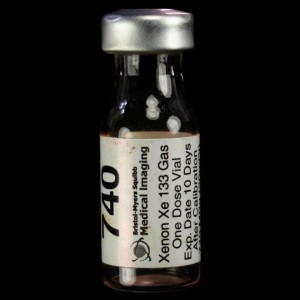
In tonight’s entry in The Chronicles of Dubious Science Reporting, you could track the high achievement in atomic-powered journalism by whether the copy-editors at a particular news source knew how to spell  “xenon.”

In reporting the “detection” of radioactive isotopes “from Japan” in Nevada today, at least Nashville’s WTVF-TV, USA Today, and the Denver Post knew that it’s spelled “xenon.” The Las Vegas Sun, the Boston Herald, KMOV St. Louis and CBS News called it “zenon” when reprinting the Associated Press story. Whether that meant they introduced the error or the AP got it wrong and then fixed it, I don’t know.

Either way, the quantity discovered is surely irrelevant in health terms. But the source is not the EPA, which reported xenon-133 it suspected was from Fukushima detected by the US Department of Energy site in Sacramento. I believe the site the LA Times is referring to is actually a DOE site operated as part of the Comprehensive Test Ban Treaty Organization monitoring. That xenon-133 was reported in Sacramento on the 18th, making the Nevada detection almost a non-story…if it were from a good source like another CTBTO or DOE site. But it’s from a somewhat sketchy one, at least as far as it’s presented in the AP story.

That source is Ted Hartwell of the Atomic Testing Museum. The Museum is a nonprofit in Paradise, Nevada that operates in partnership with the Smithsonian. I couldn’t find any scientific credentials on Hartwell’s LinkedIn Profile, but it said he’s the Program Manager of the Community Environmental Monitoring Program (CEMP) at the Desert Research Institute. So I hopped over there and…he’s an Anthropologist.

So I find it a little questionable when AP quotes him as their sole source:

Hartwell said he’s certain the isotopes came from Japan because they’re not usually detected in Nevada. But he said the readings were far below levels that could pose any health risks.

“Unless you have an accident like this (in Japan) you wouldn’t expect to see this. No doubt it’s from Japan,” Hartwell told The Associated Press.

[Link.]


I find it even more questionable because what the news stories didn’t mention either in this article or in the earlier articles about the more credible detection of xenon-133 by the CTBTO in Sacramento is that both of the isotopes reported, radioactive xenon-133 and iodine-131, are common products used in nuclear medicine departments in hospitals. That took an old friend of mine from high school who works in nuclear medicine, who observed, “I personally vented xenon-133 into the atmosphere yesterday, and have flushed iodine-131 urine down the toilet.”

Both xenon and iodine-131 are also waste products of nuclear reactors, and likely components of the material ejected by the hydrogen explosions at Fukushima I and the venting of radioactive steam. Strangely, with a cursory look, I couldn’t find a reference for radioactive xenon-133 coming from nuclear reactors; it’s xenon-135 that’s used as a neutron absorber in reactors. Xenon-133 is a byproduct of nuclear bombs, many of which were tested in Nevada. However, it has a very short half-life — less than six days.

Look, despite everything I do sort of trust the EPA. I trust the CTBTO even more. (Not sure I trust the DOE but hey, let’s work with them). If they say the xenon-133 in Sacramento came from Fukushima…I’m willing to run with that.

But are the atoms of xenon-133 and iodine-131 in Nevada from Fukushima I? Sure, maybe. Why would an anthropologist know that? Good question. Wish AP would answer that. And why would two isotopes that are common medical waste be “not usually detected in Nevada?” Wish they’d answer that, too, or at least give me more details about the levels detected.

It’s quite possible that Hartwell has some ridiculously obvious way to know what the source of the xenon and iodine are, but damned if the American news bothers to tell me what it is. I’d really, really like to know the methodology used, because it all seems so very sketchy. At least the news is reporting the amount of radiation as tiny — which it would have to be. But there’s just too many holes in the reporting on this story to have it mean anything, even if the EPA hadn’t already reported the arrival of xenon-133 in the U.S. over a week ago.

Incidentally, the Comprehensive Test Ban Treaty Organization has been monitoring global radiation levels meticulously just like they always do. The CTBTO does it not to protect your thyroid, but to determine whether North Korea has The Bomb. That means the CTBTO is monitoring radiation at infinitesimal levels. The CTBTO site in Iceland detected radioactive fallout from Fukushima I, also at low levels.

Mixing up “xenon” (an element) and “zenon” (a Greek term related to the god Zeus) is not that big a deal. Elements are, after all, only the fundamental building blocks of nature, not something important like mutual funds or liquor. But as with all late-night news stories published on weekends, the editing got even more screwed up elsewhere. The San Jose Mercury News not only repeated the “zenon” error, but also misattributed the story, not attributing it to the Associated Press (the usual procedure in wire service stories) but crediting it to the Contra Costa Times and bylining it — I’m not kidding — as a contribution of the “Alan Smithee” of science reporters, “???”.

Does this seem nitpicky? Especially to you non-science people out there? Maybe some of you non-former-copyeditors think I’m getting uppity? Maybe some of you people are sympathetic to the plight of newspapers that can no longer afford science dictionaries? “Xenon,” incidentally, is in any dictionary, it being one of the elements in the Periodic Table and all. There’s also Wikipedia, but who trusts Wikipedia? And sure, I’ll admit that even such pinnacles of hard-news reporting as Techyum have been caught in errors occasionally. I once lackadaisically hyphenated “pigfucker,” for instance — a common error of first-year journalism students.

Okay. I’ll admit to being a hella nitpicky son-of-a-bitch. Perhaps not as nitpicky as someone without disclosed or quoted physical science credentials who scours the Nevada desert for isotopes common in medical waste and then is “sure” they’re the products of a meltdown thousands of miles away, because they’re there now and they’re usually not.

But I’m far more nitpicky, apparently, than a wire service that reports that assertion without a comment from a physical scientist of any sort.

Or can’t look up “xenon.”

Fukushima Radioactive Water “Almost Certainly” From #2 Reactor Core

March 26th, 2011 No comments

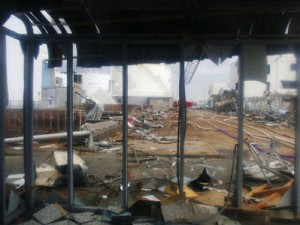
Kyodo News March 23, 2011 photo of Fukushima I, from security gate of #1 and #2 reactors.

With a spike in radiation levels detected in water pooling at the Fukushima I plant, the air in the Reactor #2 building is reported to be at 1,000 milisieverts an hour — enough to potentially cause acute radiation sickness in an exposed worker over the course of an hour. I believe that would only occur if they were without protective gear, since the 1,000 mSv/hr figure is based on the air.

An Associated Press story said that the Chief Cabinet Secretary Yukio Edano, hitting the Sunday-morning talk shows in Japan, said that the radiation was “almost certainly” seeping from a reactor core.

That would confirm what has been strongly suspected by officials for a while now — that the containment vessel itself at Reactor #2 was damaged in the hydrogen explosion, not just the containment building.

Higher-than-normal radiation has been confirmed in milk and vegetables (broccoli, cauliflower, turnips) and in tap water near Fukushima. Officials distributed bottles of water “to families with infants.”

Here another part of the AP story that’s potentially of additional concern:


Just outside a reactor at the coastal Fukushima nuclear plant, radioactivity in seawater tested about 1,250 times higher than normal, Nishiyama said. He said the area is not a source of seafood and that the contamination posed no immediate threat to human health.

[Link.]


It drives me nuts when news sources report radiation as being “X times normal.” That’s not a measurement. “Normal” varies a lot from situation to situation and site to site. So that’s not a helpful piece of information, especially since it’s unclear whether they mean “water from the sea” or “water IN the sea.” Seawater was pumped in to cool the reactor cores, so the radioactive water that is generating the 1,000 mSv an hour is probably seawater to begin with. If significant radiation has escaped into the sea itself, that’s a whole different thing.

The fact that it was addressed whether the place is a source for seafood leads me to believe that they are definitely talking about radiation in the sea itself.

However, without specifics, “1,250 times normal” is not a useful figure, and without numbers, “posed no immediate threat to human health” is nothing more than  a platitude.

Great Dorothy Young Tribute at the Daily Mail

March 24th, 2011 No comments

Detail of a photo from the Daily Mail.

If you visited Google today, you’re aware that it’s illusionist, stuntman, stage magician and Debunker of Spiritualists Harry Houdini’s 137th birthday — or would be, if he hadn’t died in1926 from peritonitis following a ruptured appendix.

Yesterday there was an AP story that Houdini’s last surviving stage assistant, Dorothy Young, died at age 103 at her home in New Jersey. But if you want a real celebration of her life — which was far more exciting than just having been Houdini’s assistant, check out the glorious celebration of her life, with many gorgeous photos, from The Daily Mail.

Here’s the short version from AP:

Young joined Houdini’s company as a teenager after attending an open casting call during a family trip to New York. During her year with Houdini’s stage show in the mid-1920s, she played the role of “Radio Girl of 1950,” emerging from a large mock-up of a radio and performing a dance routine.

Young went on to become a professional dancer, performing in several movies. She also published a novel inspired by her career.

[Link.]

The local paper The Hawkeye has another interesting bit about her:

Young then formed a dance act with Gilbert Kiamie, a New York businessman and the son of a wealthy silk lingerie magnate, and they gained international prominence for a Latin dance they created known as the rumbalero. They later married and remained together until Kiamie died in 1992.

[Link.]


But the Daily Mail story — srsly, check it for the pics. That link again…

Tags:

“Possible” Radiation Burns On 2 Fukushima Workers

March 24th, 2011 No comments

Kyodo News March 23, 2011 photo of Fukushima I, from security gate of #1 and #2 reactors.

In what appears to be the first report of possible acute injuries received directly from radiation at Fukushima, three Tepco employees were reportedly exposed to “high” levels of radiation — approximately 173-180 millisieverts — while laying electrical cables in the first floor and basement of Fukushima I’s #3 reactor. Two of the three were taken to the hospital with “possible” radiation burns on their feet.

Kyodo News reported that the injuries are from beta radiation, one of four types of radiation at Fukushima (gamma, neutron, alpha and beta). Beta particles are high-energy, high-speed electrons emitted by some radioactive materials that can in some cases cause cancer and death. However, the amount they received appears to be well below the threshold for causing radiation sickness. The amounts reported are markedly above the technical minimum established potentially carcinogenic dose, in practical terms, from what’s being reported now, the workers are likely not to be at significant risk for cancer. From what I can tell, they are unlikely to even have actually received burns — meaning the trip to the hospital is probably precautionary.

Alpha and beta radiation does not penetrate material the way that gamma and neutron radiation does; alpha and beta are only really a problem when they’re ingested or absorbed through the skin. A whole lot of variables determine how serious or dangerous the exposure was, so it’s impossible to tell whether this is a serious incident. Nonetheless, it clearly doesn’t represent anything like an overall escalation of the crisis.

Kyodo News reports that the three workers had stepped in a puddle with about six inches of radioactive water. According to Tepco, they had not tested the radiation at the puddle before they stepped in it, and their protective boots may have leaked, exposing the employees’ feet to beta radiation severe enough to cause, in two of the three cases, burns severe enough to require a trip to the hospital (which may have been precautionary).

As I understand it, the potential for beta burns would be measured in grays, which is an absorbed radiation dose equal to a Sievert per kilogram of tissue (1 Sievert to 1 kg of tissue = 1 gray). That would make 173-180 mSv well below the level where any clinical effect would be seen — but there are many other variables to consider. Since beta radiation is a non-penetrating radiation, skin burns would come from the contact of radioactive material (in this case, in the puddle water) with the skin. The acute danger is dependent on how long the water was in contact with the skin, and whether any of it was in contact long enough to be absorbed. If I’m reading the US Army’s information right, it takes something like 6 grays to cause a burn, so my guess is that either the trip to the hospital was entirely precautionary, or a very small amount of skin on each worker received that 173-180 mSv. That is above the minimum established carcinogenic dose, but again, beta radiation doesn’t penetrate like gamma or neutron. While it’s also above the usual safe dose for Japanese workers (100 mSv), the level was raised by the government to 250 mSv during the crisis. In the U.S., workers have an automatic exposure limit of 250 mSv in emergency situations, and 100 mSv otherwise.

Kyodo reports the radiation at the surface of the puddle was 400 millisieverts (mSv) per hour, and 200 mSv per hour in teh air around the puddle. However, Tepco later denied there was a puddle. It’s unclear from the Kyodo report if that’s ’cause it evaporated (puddles do that sort of thing) or if the original Tepco report had been in some way erroneous.

A kind of weird headline at Kyodo News that appears to be subscribers-only proclaimed that the radiation in the water where the workers were exposed was “10,000 times normal,” which, like most reports of radiation amounts in the press, is not really a meaningful or helpful assertion but sure sounds scary.

The Fukushima 50 and the Meaning of “Sacrifice”

March 22nd, 2011 No comments

Image from Pattaya Daily.

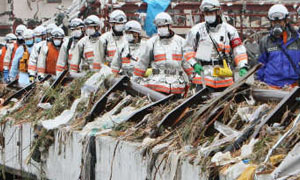
Though workers were evacuated again from Fukushima I about 20 hours ago following reports of white smoke, I am troubled by the quickness with which commentators, hungry for heroes in this whole situation, have written the Fukushima workers off as soon-to-be-dead zombies.

Before you get hopped up, let me say this: In no way am I going to argue that these people are in any way not engaged in making great sacrifices. I’m not even arguing that they’re not fully deserving of the cult of the nuclear samurai that has grown up around them.

But I have heard no credible reports that the workers at Fukushima “sacrificed” themselves…with the implication that they are certain to soon be dead, which implies that they are in the “walking ghost” phase of acute radiation sickness. I’m not going to play pro-nuclear-roulette and claim that won’t happen. I’m just going to say that I’ve seen no credible reports of it, and yet I hear that claim repeated and repeated and repeated.

It may be an appealing myth — and it may even be true. But to my mind, it has not been established credibly. To pretend that it has is to misunderstand radiation. It’s also to cast aspersions on the workers’ real sacrifice. What happens “if” they all live? Is that a “miracle”? Or is it proof that the Japanese safety procedures were not as bad as we thought they were? Maybe it could even be taken as proof that the cult was fraudulent from the beginning — which it is not, or at least it shouldn’t be. The fact is, the real sacrifice comes from a shared sacrifice of establishing and evaluating risk, and very brave people taking individual risks when things go wrong.

But if the rest of us think we’re asking the Fukushima 50 to crawl into a melting-down core to save our asses, we’re grossly mis-evaluating the value of infrastructure. Building credible and defensible infrastructure is not about cheering cannon fodder. It’s about respecting the people who make sacrifices to keep the world running.

Japan, as an IAEA state, would be obligated to have already reported acute radiation sickness cases, and based on their own guidelines the workers still cannot be exposed to anything more than 250 mSv, or millisieverts — which is a LOT of radiation, and not a party. It places one at a definite and clearly established elevated risk for cancer. But it sure as hell does not indicate instant death.

The Fukushima 50 were selected from older workers not because they have “less time to lose,” but because the effects of ionizing radiation too low to cause acute radiation sickness are still high enough to cause an established increase in cancer and birth defects. Older workers have less time ot live — which means they are less likely to develop those cancers before they would die otherwise. They’re also past their childbearing years, limiting the likelihood of birth defects. Current limits on workers’ exposure are too low to cause radiation sickness. Are the government and Tepco lying about how exposed the current workers are? I have no idea either way, but if you would like to manufacture scenarios, feel free. But that’s what you’re doing. There’ve been no reports of radiation sickness.

Nonetheless, the talk of the workers’ “sacrifice” continues, to my mind — and I hope you’ll meet me halfway here — turning the workers’ real sacrifice into a soundbite because we love soundbites. The implication is that the older workers are being placed in harm’s way so that the younger workers can live on into the brave future. It might be appealing (though I, personally, find such a proposal ghoulish — and those who take pleasure in it more so). This is a soundbite that is being grabbed by those who love drama, and the lack of credibility in the “sources” won’t change the fact that plenty of people will believe it to be true. For how long will the older workers be said to have been selected because they have less ot lose?

The 31 workers who died of radiation poisoning at Chernobyl did sacrifice themselves. They placed themselves in the path of certain death, as did those at Chernobyl who did not die. Chernobyl was a different plant, a different country, a different decade.

The Fukushima 50 are to be admired. These workers have balls of brass. They are brave as hell. They are heroes to the Japanese nation, and should be considered heroes to the world. But claiming they “sacrificed” themselves is slamming the coffin door shut before any of the real information is out there. It’s disrespectful to them, and disrespectful to the man, many firefighters and rescue workers who sacrifice themselves every day all over the world because that’s their jobs.

Just because radiation is shiny and battling a meltdown seems more ghoulish to us, that doesn’t mean it needs to be dramatized any more than it already is. The situation is dramatic enough, and the workers are doing a tough enough job. They are taking enormous risk to benefit the rest of us, like the American rescue workers who were sacrificed on 9/11. But speaking of “greater” and “lesser” sacrifices misses the point of any kind of service. These workers are brave, brave, brave, and they are to be admired. You should tell their kids about them and hold them up at examples of what it means to agree to do a thing, and then actually do it even when it turns out to be a real bitch.

But we should let them be heroes without writing them off as corpses.

The statement about “sacrifice” was made repeatedly in the media, but tended not to show up in print. Then it was repeated again and again, primarily in online forums, like UFO/Conspiracy site GodLikeProductions, which is coming up in the top three on numerous Google searches related to Fukushima. Those cats have some serious Google mojo.

Also showing up at the very top of the Google searches for “fukushima sacrifice” are NewsWarped.com, which uses the observation that “officials denied the workers are on a kamikaze mission” to create a sort of confirm-by-denying flavor of not-quite-a-lie. It also strikes me as mildly racist to equate the kamikazes of World War II, who were “sacrifices” to a desperate collision of Imperial constructs, with trained workers in a highly developed and complex society. These people are trained professionals, and they are to be admired without being turned into martyrs before their time.

With all of these, writers used the “officials deny” claim as a cover for making their own assertions, which are not then supported by the evidence.

Even worse were the opportunistic squatters at ExplosionJapan, which was registered on 12 March 2011. They used explicit descriptions of acute radiation sickness to terrify and delight, and as a result they ended up at the very top of relevant Google searches.

In this and other cases, the implication or explicit statement is that the workers have acute radiation sickness. Do they? I don’t know. But there is no credible information to indicate it.

Based on the emergency provisions approved by the Japanese, the workers’ exposure was still, even given the emergency situation, limited to 250 mSv, or millisieverts, which is markedly less than the 1,000 mSv that causes acute radiation poisoning. It is higher than the 100 mSv dose that is the lowest established carcinogenic dose.

However, that does not mean they workers will be dying of cancer any time soon. They might, but we don’t know for sure. There are too few test cases to be sure.

These workers agreed to assume a very large risk, and frankly that should be enough. If drama queens the world over want to bump them off because it’s more intoxicating to have brave martyrs than live heroes, fine. But it’s not supported by evidence currently available. Please prove me wrong in the comments if you wish — links are appreciated.

In the meanwhile, I wish everyone would quit slamming the coffin lid.

How Much Spent Fuel Is At Fukushima?

March 22nd, 2011 No comments

From the Union of Concerned Scientists.

With the spent fuel pools reportedly heating up again, the claims are flying fast and furious (again) about how much spent fuel is at Fukushima. It’s deja vu all over again.

At online forums like GodLikeProductions.com, where they never met a conspiracy theory they didn’t feel like massaging into a panic, the claim is that we’re talking about a few thousand tons. That, of course, is complete and utter conspiracy-theory nonsense, unless you plan to believe those whacked-out hollow-earth weirdos at fringe journals like Scientific American or the “experts” at the Union of Concerned Scientists, who say it’s…a few thousand tons.

So let’s do some math, shall we? This is not my subject, but then, neither is nuclear engineering. Or chemistry. Or physics. Or graphs. I do sometimes read XKCD, however, so I feel sort of like a qualified mathematician when I chuckle knowingly at math jokes.

The screenshot above is from the All Things Nuclear site from the Union of Concerned Scientists, which is strongly anti-nuclear but as far as I can tell, generally not prone to pseudo-science.

Importantly, the figures quoted in the graph above represent fuel assemblies, not kilograms. Each assembly is about 170 kilograms, not all of which is nuclear fuel but all of which is highly radioactive (though it depends on how you define “highly.”

For you non-metric types, a kilogram is 2.2 pounds. For you non-British-system types, when Americans talk “tons,” they mean 2,000 pounds.

Therefore, if you believe these figures, and if I am understanding these figures, the amount of spent fuel stored at Fukushima I, in the pools, as of March 2011, is about 2,000 tons. These assemblies are not stored in one single pool, so a single compromise of cooling (or, say, a re-criticality) does not compromise all of the spent fuel. From these figures, the single pool at Reactor #4 that was having the biggest problems last week has about 248 tons of spent fuel, not the 172 tons that I originally reported.

The Reactor #4 pool includes, apparently, the spent fuel assembly from Reactor #4, which was shut down prior to the earthquake. That is more recently decommissioned fuel, more fissionable, and more likely to enter re-criticality (also much more likely to heat up). In fact, it is the presence of the recently decommissioned fuel from #4 that made re-criticality any sort of risk, apparently.

The site referenced above says the recent fuel from Reactor #4 was 548 assemblies (about 102 American tons), which was added to 783 assemblies (about 148 tons) already in the pool. As the Union of Concerned Scientists observes, the Kcal calculations mean the heat put out by the 783 older assemblies must be negligible.

For the purposes of this information, I have omitted the dry cask storage, since it does not require cooling. It’s older fuel and less fissionable. I’m not so sure that makes it any less hazardous in long-terms, but that’s a matter of getting real specific about what you mean by “hazardous.” In terms of the cooling problems, only the pools are directly relevant.

Unfortunately, the information is out there to look at, and it all seems to more or less agree. Whether you want to believe Scientific American, the Powerpoint over at the anti-nuke Nuclear Information and Resource Service, or the Union of Concerned Scientists, it looks like we’re talking about several thousand tons of spent fuel, and around 250 tons in the Reactor #4 pool they’re still having trouble keeping cool.

Fukushima Particles Detected in Iceland

March 22nd, 2011 No comments

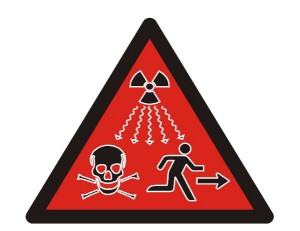
New(ish) radiation hazard symbol, launched by the IAEA in 2007.

Amid several myths and items of questionable provenance from Fukushima, the story about the radioactive particles in Iceland seems to be accurate.

The report comes from the Comprehensive Test Ban Treaty Organization, which monitors such things as a way of keeping track of possible nuclear tests worldwide. The reported radiation from Fukushima has been confirmed through “multiple diplomatic sources.”

From what I can see, the particles are almost certainly of no clinical relevance whatsoever — which is to say, it is incredibly unlikely there will be any measurable health impact from them.

Seriously. As in, none whatsoever, srsly. That hasn’t been confirmed from authoritative sources, but the clinical irrelevance seems really clear given everything that’s been tracked about the site. One of the things that I’d like to take away from the Iceland report is a confidence that radiation really is being monitored and reported worldwide. And I think that’s important.

Tags: