Archive

Archive for August, 2011

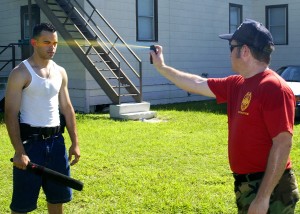
“Less Lethal” Weapons

August 10th, 2011 No comments

Public Domain image of US Navy pepper spray demo.

After viewing the likely-to-be-censored Al Jazeera documentary “Bahrain: Screaming in the Dark,” it’s particularly creepy to read this August 1 article from Alternet about less lethal weapons available to or anticipated by the military and police around the world. The technologies include blinding lasers, microwaves and sound weapons. Of course, I knew about them all from watching The History Channel. But then, I’m not some Alternet hippie, now, am I?

Here’s Alternet’s Rania Khalek with her take:

The demand for non-lethal weapons (NLW) is rooted in the rise of television. In the 1960s and ’70s the medium let everyday Americans witness the violent tactics used to suppress the civil rights and anti-war movements.

Today’s rapid advancements in media and telecommunications technologies allow people to record and publicize images and video of undue force more than ever before. Authorities are well aware of how images of violence play out publicly. In 1997, a joint report from the Pentagon and the Justice Department warned:

“A further consideration that affects how the military and law enforcement apply force is the greater presence of members of the media or other civilians who are observing, if not recording, the situation. Even the lawful application of force can be misrepresented to or misunderstood by the public. More than ever, the police and the military must be highly discreet when applying force.”

The global economic collapse coupled with the unpredictable and increasingly catastrophic consequences of climate change and resource scarcity, along with a new era of austerity defined by rising unemployment and glaring inequality have already led to massive protests in Spain, Greece, Egypt, and even Madison, Wisconsin. From the progressive era to the Great Depression to the civil rights movement, Americans have a rich history of taking to the streets to demand greater equality.

[Link.]


Al Jazeera Cancels Re-Airing of Bahrain Documentary

August 10th, 2011 No comments


Al Jazeera has cancelled plans to re-run its 50-minute documentary “Bahrain: Shouting in the Dark,” under pressure from Bahraini leaders — who are good friends with Al Jazeera’s patron, the Emir of Qatar. The documentary concerns the brutal suppression by the government of this year’s protests in Bahrain, “An Arab Spring abandoned by the Arabs.”

Bahrain is a Shiite-majority nation with a Sunni royal family widely seen as hugely corrupt and strongly anti-Shiite. The royal family’s connections are strong to Sunni Saudi Arabia (which contends with a Shiite majority on the rim of the Gulf) and Qatar. It was surely Al Jazeera’s connections to the leadership of Qatar that allowed its TV crew to be the only one remaining in the country during the brutal suppression.

Embedding is disabled for it on YouTube, and people I spoke to seemed to think it’s not unlikely the video will be pulled, so if you’re interested in what happened in Bahrain, “An Arab Spring abandoned by the Arabs,” watch it while you can. Even if AJ pulls it, it’s almost guaranteed that “Shouting in the Dark” will stay available on some level. Thanks to today’s ultra-spiffy high-tech technology, culture commandos and rebellious ragamuffins alike can download anything from YouTube with free software — not that the rule-of-law-loving readers of Techyum would ever do that with copyrighted material, let alone material that had pissed off that great Friend of Techyum the Emir of Qatar.

Like most documentaries attacking the entrenched power structures of Arab countries, this documentary has garnered many “dislikes” One of the commenters claiming to be a Shiite (presumably from the upper class, if it’s true) shows up as the first comment in English:

What is eye opening to me…is the amount of backwardness that I never knew existed in Bahrain. I have lived in Bahrain all my life, and I never thought there would be this amount of racism, sectarianism, hate, and stupidity in a sizable group of the society. The 616 people who disliked this video, and some of the disgusting comments written here make me wonder if these people have always hated me as a shii’i, but never showed it to my face until now. Very sad.

[Link.]

More info on the controversy can be found in yesterday’s New York Times story by Brian Stelter:

The decision this week to halt the repeats raised concerns among Al Jazeera’s staff members that the channel was succumbing to political or diplomatic pressure from Bahrain and its ally Saudi Arabia…The episode illustrates the thorny issue of independence for Al Jazeera, one of the world’s biggest satellite news organizations, which is financed by the emir of Qatar and is perceived by some people to be a diplomatic tool of the country. Al Jazeera insists that the Qatari government does not interfere in the network’s editorial operations.

Al Jazeera’s Arabic and English language channels both came under scrutiny in February and March for their coverage of Bahrain, an island kingdom just north of Qatar in the Persian Gulf. Viewers perceived that the Arabic channel, in particular, paid less attention to the Bahraini protests than it did to the earlier protests in Tunisia and Egypt. Qatar joined Saudi Arabia in sending troops into Bahrain to violently quell the protests in March.

Bahraini authorities helped to limit news coverage of the crackdown by blocking journalists from entering the country and expelling some who were already there.

Some video still surfaced, however; “Shouting in the Dark,” which was first televised last Thursday, featured footage that was secretly recorded during the protests, showing brutal violence and desperate scenes inside hospitals. The documentary contrasted that footage with the claims that were made at the time on state television.

[Link.]

Incidentally, predominantly Shiite pro-democracy movements in Saudi Arabia and Bahrain surely stress out the power structure in the U.S. as much as anyone. That’s because “axis of evil” member Iran is the largest Shiite nation. It is through the Shiite community in Lebanon that Iran has gained a covert foothold with its proxy Hezbollah, which was able to defeat Israel in the 2006 war owing to Iranian training and support. Also, the Iranian influence in Shiite-majority Iraq is one of the many things that the Bush administration didn’t plan for. (The Bush team apparently believed, according to Peter Galbraith, that Arab-Persian communities were  more alienated from each other than  Sunni-Shiite communities — a fairly ludicrous concept to anyone familiar with the Gulf.)

Furthermore, the Saudi Arabian rim of the gulf, close to Bahrain, is majority Shiite and has a notable Persian cultural influence; Shiites in Saudia Arabia are hugely discriminated against. That fact undermines the security of the security of the Saudi Gulf oilfields almost as much as the missiles Iran has pointed at it from just across the Gulf. The Gulf oilfields close to Iran are some of the richest oil sources in Saudi Arabia’s vast reserves; a pro-democratic Shiite revolution there is often cited as one of the major threats to American global hegemony and, in particular, oil security.

Once again, unfortunately, the U.S. and its close allies turn out to be on the side of a brutal dictatorship in order to secure perceived economic gain. The result is that rather than nurturing democratic reforms through diplomacy, we’re left howling “Wha-happen!?!?” and wondering why everyone hates us. American prestige in the Islamic world, at an all-time high during the Clinton years, takes yet another hit.

The result? The oppressed Shiite communities of the Gulf will move not toward the institutions that should be their natural allies in attaining Democracy and self-determination — the United States and the United Nations — but toward their natural allies in sectarianism, anti-secularism and anti-Western sentiment…Iran.

As an American, that‘s what I find sad.

Tags: ,

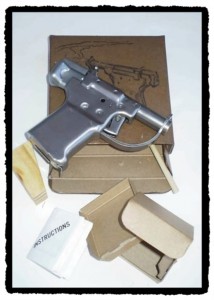
The .45 Liberator Replica: A Pricey Piece of Budget History

August 7th, 2011 No comments

In the 1940s, the United States military developed an ultra-cheap, ultra-simple single-shot .45 handgun stamped out of sheet metal. It was designed to be airdropped by the OSS to insurgents in Nazi-controlled Europe in vast numbers. Called the FP-45 Liberator, the pistol became one of the most curious-looking entries in the history of firearms. It’s also one of the most collectible firearms around, with pristine copies without the box and instructions run somewhere between $2,000 and $3,000 nowadays, according to the latest issue of Guns & Ammo. Want one with the box? Expect to pay more.

But don’t fret! The selfsame article in G&A notifies me that Vintage Ordinance now offers an replica of the Liberator. Priced at just $599, the weapon will set you back a few dollars more than the original U.S. Army unit cost of $2.40 per Liberator (which is about $32 in today’s currency). The replica, like the original, loads .45 ACP ammunition, but you want to know the great part? You’re not supposed to fire it. No, seriously…Vintage Ordinance has created a firing replica of which they say the following:

Though our reproduction is sold as a firearm and exceeds the mechanical strength of the original through the use of superior materials and vastly tighter chamber and headspace tolerances, WE STRONGLY ADVISE CUSTOMERS NOT TO FIRE THE PISTOL. During production in 1942, several examples were taken from the assembly line to test under repetitive fire. Reports indicated that after 50 rounds of service ball ammunition the testers felt the weapons were no longer safe to fire. They were simply never designed handle a steady diet of powerful .45 ACP. They were made to fire ten rounds. They are what they are.

The original FP-45 is a clever and efficiently designed weapon but it has never received any accolades for operational safety. Once it is loaded, the only safe way to handle it is with the zinc cocking piece turned fully 90 degrees to the right or left so that the rear corner of the pistol’s grip frame will prevent it from rotating into firing position. If the cocking piece is re-aligned and the guide pin inserted through the hole in the cover slide as illustrated in the original instructions, THE PISTOL IS COCKED AND READY TO FIRE. IF DROPPED IN THIS STATE, IT COULD EASILY DISCHARGE CAUSING INJURY OR DEATH.

Just what I need in my cedar chest…a highly dangerous collectible that I’m advised not to load and fire because it will kill me. But then…if they’d made it a non-firing replica, like any sane person woulda, they couldn’t charge six Franklins for it. I think the subtext here is that, wink wink, you are going to fire it, but, wink wink, that’s very naughty of you, wink wink, and so don’t blame us when it kills you. Awesome! Needless to say, if you’re buying it for collector’s value, you’re better off not firing it anyway.

Given its single-shot nature, the Liberator is a derringer, with two r’s and a small d, by some definitions — as opposed to a Deringer, which was a trade name from which the generic term originated. Still, it doesn’t look a damn thing like what you’d expect Three-Card Zeke to sneak out of his vest pocket when he’s caught cheating at poker. It’s a curious and ugly device made to be created as cheaply as possible, representing the ingenious desperation of a nation at war.

Sadly, desperation and ingenuity may go well together in terms of economic firearm design, but when it comes to continent-wide strategy, they’re not the best bedfellows.

The Liberator was intended to be a weapon of psychological warfare and even terror, creating the sense in the occupying force that they might be killed at any moment by a civilian stashing an easy-to-conceal firearm. But while that might sound like a nice goal for a major country supporting an insurgent force, other U.S. strategies proved to be a hell of a lot scarier. What’s more, the OSS always thought it was a jackassed idea, and very few of the Liberators manufactured were distributed, mostly in China and the Philippines. There’s no recorded instance of a Liberator being successfully used in the field. It was as half-baked an idea then as it is now.

But who gives a damn? It’s a piece of history, and a great example of the many ways in which complex engineering can be reduced to its bare basics. Six Franklins?

Both the original and the replica come complete with a wax box and instructions on how the recipient could use the gun to kill a German guard and commandeer his rifle or submachine gun…and presumably accomplish this before ol’ Hans-Jürgen’s buddies hear the gunshot and get all Night of the Long Knives on your ass (the single-shot gun did not include a silencer).

The original also had a smoothbore barrel, which makes its claimed range of about 8 meters or 32 feet seem a little optimistic, especially since insurgents were likely to be doing their work at night. The replica has a rifled barrel, because federal firearms regulations in the U.S. make it illegal to sell smoothbore handguns.

Tags: ,

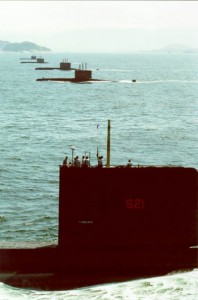
Brazil Building Nuclear Subs to Defend Oil Reserves

August 5th, 2011 No comments

Brazilian submarine formation. Copyright: Navy of Brazil.

Here’s a turn of South American politics that seems like reality straight-up shoplifting from a cyberpunk novel….or one of several earlier Techyum posts.

If you need proof that the wars of the 21st century are going to be fought not over principles, democracy or even national hegemony per se, look no further than this Al Jazeera story about Brazil building a nuclear submarine to defend its oil reserves:

Plans for a Brazilian nuclear submarine that had been postponed since the 1970s are beginning to materialize, as the nuclear-propelled sub is regarded as a strategic necessity to guard Brazil’s deep water oil reserves, and to project global power.

“Brazil is taking another step toward affirming its status as a developed country with sophisticated industry capable of absorbing, mastering and using advanced technologies,” said Brazilian President Dilma Rousseff. [The project] originated in a December 2008 agreement between French President Nicolas Sarkozy and former Brazilian President Luiz Inácio Lula da Silva. …”Brazil is taking another step toward affirming its status as a developed country with sophisticated industry capable of absorbing, mastering and using advanced technologies,” [said Rousseff].

If it seems strange to you that the French are lending a hand to the Brazilians in developing a nuclear submarine program, it’s actually not. The French are big global arms suppliers, and have long have a critical link with the Brazilian navy. The only Brazilian aircraft carrier, the São Paolo, is the former French carrier Foch — interestingly, the same carrier that featured in the opening narration in the 1995 nuclear-war epic Crimson Tide. The Foch is a non-nuclear vessel (as far as I can tell, diesel-electric) as are all of Brazil’s ships.

Of the 100 currently commissioned ships of the Brazilian navy, very few are of French origin. Most of those not built in Brazil originated with the United States, United Kingdom, or Germany. All of the Brazilian ships under development are from France or Italy. That signals a clear shift of geopolitical alliances — one that’s pretty serious, given that Brazil is very much on the ascendency and the U.S. just had its credit downgraded.

And what of a nation developing a nuclear-propelled submarine force, with conventional arms, to protect its oil reserves? The truth is, that’s not very far away from what the United States, Britain, China, the Soviet Union and now Russia have been doing at least since the end of World War II. All this crap about furthering global democracy and/or Communism is, depending on how you wanna frame it, either a complete scam or is part and parcel of defending oil reserves and other natural resources.

Of course, the most important thing a country’s military defends, at least on the U.S. model, is the opportunity to make money.

Which is why the Brazilian nuclear subs will not be built in France; they’re Brazilian jobs, with French technology. It looks to me like Brazil is doing exactly what the U.S. does when Brazil’s Embraer tries to woo them — tries to bring the project into the local economy, though that often ends up being a bit of a scam. Politicians’ claims that local jobs will be provided could mean anything or nothing…just like in the U.S. They might be lies, damn lies, or more damn lies, but two things are for sure…these subs are nuclear; and they’re being built with French technology, not U.S.


Tags:

German Teen Mag’s Victim-Blaming Date-Rape AIDS Panic Photostory Ist Nicht Ganz Toll

August 4th, 2011 No comments

Screencap from Bravo.de.

CAUTION: The following references to some seriously hateful victim-blaming in a fictional case of date rape may prove triggering to some of you. It certainly did the author. Reader discretion is advised.

The German magazine Bravo is a mainstay among German teens. In its hallowed pages can be found celebrity news on truly awful American celebrities, as well as German ones. German teens also look to the magazine for guidance in conducting their sexual affairs. Unfortunately.

You see, Bravo has long published a series of really weird PG-rated photostories about teens’ sexual exploits. When I say “photostories,” well, you may recall those weird little glossy-paged paperbacks you could pick up in the ’70s and ’80s that would retell stories from The A-Team, the pilot episode of Airwolf, or Planet of the Apes, or, say, Ordinary People in stills and speech bubbles. It’s like that.

Only in Bravo’s photostory “Der One-Night Stand,” which was originally published in 2006 and then recently reposted, we have not The Star Wars Holiday Special in photocomix, but a PG-rated cautionary tale about Sandy, 16-year-old girl who is annoyed by her boyfriend Basti’s obsession with football. She goes out and gets drunk, then gets date raped by Rob, who turns out to be HIV positive.

Guess whose fault this is, in the twisted logic of this hate tract? That’s right, Sandy’s to blame! In fact, the blame she places on herself is presented in the story as entirely appropriate. The situation is portrayed as “cheating” — and all Sandy’s fault — even though it’s clearly a blatant case of alcohol-facilitated date rape.

It gets worse. After Sandy’s best friend distances herself from Sandy, apparently creeped out by the idea that Sandy might be HIV positive; that doesn’t stop Sandy from taking her friend’s advice about getting an HIV test. Appaerntly, in the warped photocomic’s counter-Germany, she has to wait twelve weeks for the results. This is a grotesque piece of misinformation obviously intended as a scare tactic — HIV results haven’t taken twelve weeks, to my knowledge, ever. Maybe they do in Germany, but I doubt it. I suspect that’s nothing more than an attempt to make HIV seem more deadly and mysterious to scared teens than it already does.

Don’t worry, though — Basti responds to Sandy’s confession of “guilt” in “cheating” on him by — anyone? — That’s right, kicking her rapist’s ass! The only problem? Anyone? That’s right! Basti gets blood on his knuckles! As the story closes, we’re left wondering whether Basti himself may seroconvert, and, yes, it’s all Sandy’s fault.

If it seems like I’ve been engaging in a little Frölichkeit above, you should know that the fun stops here.

You can read “Der One-Night Stand” in German here, though if you’re not a German-speaker you should be warned that Google Translate chokes on German colloquialisms — not to mention pronouns and cases. What’s worse, Bravo.de is so badly designed and loaded up with unending ad scripts as to make the photostory almost unreadable (which in some ways may be a blessing). So maybe that’s contributed to my righteous fury — clawing my way through more than sixty pages of this crap was a bit more than I signed on for.

The far more important caution is that “Der One-Night Stand” is one of the most offensive things I’ve ever read. I see it as a straight-up misogynist hate tract that is packaged as a cautionary tale. It’s not just triggering because of its portrayal of date rape; it’s the hateful victim-blaming and the blatant disregard for HIV-related facts that makes it impossible for me to read without wanting to break something.

Keep in mind that this is a mainstream media outlet for teens, not propaganda put out by some weird reactionary fringe group. And it was originally published five years ago, whereupon we heard not a peep.

When “Der One-Night Stand” was reposted recently, it came to the attention of Nadine Latsch at German feminist blog Maedchenmannschaft.net. She posted a commentary on the abominable thing. With a little help from Twitter and Facebook, she started a firestorm of German-language controversy that’s grown to the point where ABC News is covering it.

The hysteria fueled by victim-blaming lies and misinformation like this contributes directly to teens feeling of sexual disempowerment, which contributes to a failure to take appropriate safety measures. The chance of Basti contracting HIV, for instance, from a fistfight, is virtually nonexistent in practical terms. More importantly, it’s completely insignificant compared to the hysteria such a fear causes in teens who are not at risk…but might put themselves at risk if they feel disempowered by risky behaviors’ seeming (fraudulent) ubiquity.

Most important of all, what Sandy experiences is date rape, not “cheating.”

Those were some of the issues voiced by Lantzsch in her blog post about the piece. Here, her German-language post is paraphrased by ABC News:

In her blog entry, Lantzsch writes that, in the piece, Bravo has “portrayed non-consensual sex without exploring the problems relating to it.” Lantsch told SPIEGEL ONLINE by phone that she has since complained to both the editors at Bravo as well as its publishing house, Bauer. Lantzsch said she is concerned that the photo story does not sufficiently describe the encounter depicted in the story as sexual violence. And that’s not the only problem with it.

…”In addition to belittling rape and victim blaming, (Bravo) has also included prejudices about those ill with HIV — portraying them as pathological and socially isolated — people who ruthlessly ‘infect’ others just as soon as they have the opportunity,” Lantzsch writes in her blog entry.

Lantzsch says that she and her colleagues at the maedchenmannschaft.net blog often inform companies and media of such mistakes, but that they are often brushed off by the editors. “It isn’t seldom that we get answers like: ‘You didn’t understand the joke’,” she says.

[Link.]

That’s more or less what the publisher of Bravo.de has said in response to the criticism, and as far as I can tell the controversy has dropped off the map. A magazine responsible for giving lifestyle information to teens has created one of the most awful examples in history of misogynist rape-apologist propaganda, and it’s all blown over.

The photostory is still up, still pumping out its hateful victim-blaming nonsense and viral misinformation.

Tags:

Radiation Soars at Fukushima — to 10 Sieverts Per Hour

August 2nd, 2011 No comments


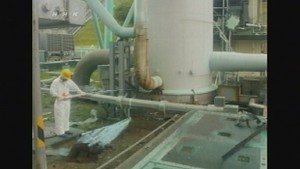
Image from NHK.

NHK English, and Al Jazeera (but, weirdly, not yet The Japan Times) are reporting that the damaged Fukushima nuclear power plant is showing levels of localized radiation potentially lethal to humans in just minutes –high enough to actually go off the scale of the plant operator’s Geiger counters. Now, the reports are of localized radiation of at least 10 sieverts per hour — according to the plant operator TEPCO, that’s enough to cause severe radiation sickness in humans after just a few seconds of direct exposure.

I say “at least” because that’s as high as the Geiger counters go, so there’s no way to tell. The speculation is that the radiation comes from material left over from emergency venting in the first few days of the crisis, rather than some new breakdown. But it’s worth pointing out that such an answer would mean the radiation had been there the whole time.

Interestingly, while NHK refers to the hotspot as an “exhaust pipe” — ulp — Al Jazeera prefers to call it a “ventilation stack” — slightly less scary, eh? The radiation has shown up, from what I can tell, in two spots in the same pipe/stack. Here’s what NHK says:

The operator of the crippled Fukushima nuclear complex is searching for radioactive hotspots after finding record high radiation near an exhaust pipe at the plant.

Tokyo Electric Power said on Monday that over 10,000 millisieverts per hour had been detected at the bottom of the exhaust pipe in between reactor buildings No.1 and No.2. That’s the highest level detected since March when the quake and tsunami disabled the plant.

A photo released on Tuesday shows workers taking measurements with a detector attached to the tip of a 3-meter-long arm. The level of radiation where the workers stood reportedly reached 40 millisieverts per hour.

TEPCO says the exhaust pipe was used when radioactive air was vented from the No.1 reactor’s containment vessel one day after the March 11th disaster.

The company subsequently revealed that the reactor had suffered a nuclear fuel meltdown. The utility believes highly radioactive substances that leaked from the container flowed into the pipe and accumulated inside.

[Link.]


What appears to be a second hotspot is mentioned by Al Jazeera:

“Authorities are working on the theory though that it has come from those initial hydrogen explosions that we’ve saw at the plant in the days after the earthquake and tsunami,” [the correspondent said]. …”It is now looking more likely that this area has been this radioactive since the earthquake and tsunami but no one realised until now.”

On Tuesday, TEPCO said it found another spot on the ventilation stack itself where radiation exceeded 10 sieverts per hour, a level that could lead to incapacitation or death after just several seconds of exposure.

The company used equipment to measure radiation from a distance and was unable to ascertain the exact level because the device’s maximum reading is 10 sieverts.

[Link.]

A level of 10 Sieverts (Sv) per hour, incidentally, is kind of a lot of radiation. I was slightly dubious of the correspondent’s claim that it can cause radiation sickness after a few seconds, but TEPCO’s math is actually not that far off the mark, especially since the level could be far higher than that.

The safety limits for workers at Fukushima is 250 millisieverts (mSv) per year. Acute exposure to 1,000 mSv, or one Sievert (Sv) total is generally considered enough to reliably cause mild radiation sickness (often only half that, but it varies widely). Keep in mind that the measured localized radiation is ten times that — but only because that’s where the equipment stops measuring it.

Image by Randall Munroe at XKCD.com.

According to XKCD’s handy radiation exposure chart (reposted at right), acute human exposure to 8 Sv total is thought to result in death even with treatment; 4 Sv is usually fatal even with prompt treatment; 2 Sv causes severe and possibly fatal radiation sickness. A total exposure of 10 Sv would absolutely be fatal, even with treatment, so the fact that 10 Sv/hour is the limit of the equipment is pretty significant.

At 10 Sv/hour, my sketchy math skills give me something like two minutes and fifteen seconds to possible acute radiation sickness, so…”a few seconds” might be pushing it, but it’s sure as hell not a cakewalk. Radiation exposure over a short period of time also causes more acute effects.

Los Alamos physicist Harry Daghlian, by comparison, received an estimated dose of 5.1 Sv in the August, 1945 criticality experiment with the “demon core” that also killed self-described “bomb putter-togetherer” Louis Slotin the following year. Daghlian died of acute radiation syndrome 25 days after the first accident. Slotin (who, incidentally, consoled Daghlian as he died) probably received 21 Sv in the second accident, and died in 9 days. Both exposures were for just a few seconds.

The local Fukushima levels measured — that is to say, the limits of the equipment — therefore represent about twice Daghlian’s exposure, or half Slotin’s, per hour, compared to the few seconds that resulted in the exposures in the two Los Alamos accidents.

Harry Daghlian, Creative Commons from Wikipedia.

It’s slightly disingenuous to compare these events, because they have so little to do with each other. Daghlian and Slotin were not wearing protective gear. They both received direct bursts of radiation from weapons-grade plutonium, which is the same grade of plutonium used in Fukushima’s mixed-oxide or MOX fuel — but in MOX it’s not in pure form. Many things affect the level of ionizing radiation absorbed by human tissues, including the exact kind of radiation, and what tissue is absorbing it; its not just apples-to-apples, here. The number of case studies of acute human exposure to high levels of ionizing radiation from fissionable material is, thankfully, pretty damn limited. We don’t know all that much about what radiation this intense would do to a person, because luckily not that many people through history have been exposed.

And it’s also worth observing that Slotin’s and Daghlian’s exposures were only for a few seconds because the accidents only lasted a few seconds. The measured radiation at Fukishima has, the theory goes, endured since the inception of the crisis (or shortly thereafter).

There’s no evidence that this specific 10+ Sv/hour source of radiation has any access to the environment — the ocean, groundwater, etc. — now, or at any point in the last few months. But the radiation, by definition, must be coming from some material.

Is that material properly isolated from the environment? Clearly not by intention, since plant workers just found out about it. Probably not by design, since it’s somewhere it’s not expected, and the protective structures at Fukushima were unquestionably compromised. Assuming it’s been there for months, might it have been kept isolated from the local environment by pure chance and dumb luck?

Louis Slotin's Los Alamos badge photo. Public Domain, from Wikipedia.

Sure…maybe.

That said, the currently available descriptions represent no specific threat whatsoever from this specific radiation to the immediate environment, let alone the global environment (overall at Fukushima? That’s another story entirely…). However, I mention the examples above to describe just how astronomical the difference is between the levels reported thus far at Fukushima and the levels being discussed now. No humans have been exposed to that level of radiation — and again, keep in mind that no one involved in the Fukushima accident has died from radiation, despite the widespread (though short-lived) belief in the West that the “Fukushima 50″ had “sacrificed themselves.”

But in immediately local terms (ie, at the bottom of the ventillator stack) these levels are orders of magnitude worse than what was seen during the original acute phase of the crisis after the earthquake and tsunami. We’re not talking about anything even remotely close to the levels that sent plant workers to the hospital after they stepped in dirty water. We’re talking about many times that.

If these reports are accurate, then they represent the worst radiation danger to plant workers (and, by extension, the local environment) that has ever been seen at Fukushima — including the initial crisis when things were exploding and cores were melting down. It makes the local radiation levels described in the heart of the crisis seem like child’s play. That’s partially true because, obviously, the cleanup requires plant workers to go (or send their equipment) into places that no sane person would have gone immediately following the explosions. Cleanup requires plant workers to dig deep…so they’re discovering just how serious the release of radiation was, and is.

Before North Americans reading this start packing up their Volvo station wagons with shotgun ammo and cat-carriers, you should know that the levels are more than just localized to the power plant site — they’re localized to the bottom of a single shaft (so far). But again, these levels are coming from somewhere, and it’s reasonable to think that the material putting out that kind of radiation must be going somewhere — like out to sea, for instance. Al Jazeera’s silent on that matter.


Tags: