What the Spent Fuel Pools Might Mean (It’s Probably Not What You Think)

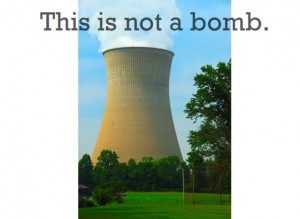
Screencap from the entry movie from pro-nuclear activist William Tucker's site TerrestrialEnergy.org.
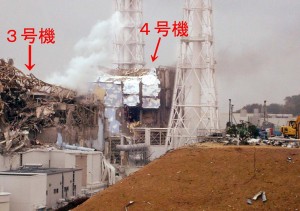
You are going to have to forgive me when I hurl a few rejoinders in the coming paragraphs. I imagine my gallows humor may strike many of my readers as just about as dry at the spent fuel pools ABOVE Fukushima I’s reactors #3 and #4 — yes, that’s right, TWO spent fuel pools, not just one, in which the “risk of re-criticality is not zero.” And they’re above the reactors.
Above.
First, Richard Black of the BBC, in a sidebar to this article:
The targets were cooling ponds situated above the reactors, which store fuel rods. The ponds in buildings 3 and 4 – and possibly more – are certainly short of water, possibly completely dry.
[Link.]
I’m sorry, did you miss it? Black said:
The targets were cooling ponds situated !!!!!!!!!!!!ABOVE!!!!!!!!!!!!!!!!!! the reactors, which store fuel rods.
…Emphasis mine.
I”m just curious. Does that sound like an awesome idea to anyone other than me? Or did nobody else get their feelings hurt by being ridiculed publicly by nuke-jocks for asking whether it was true that the China syndrome was possible. In the so-called China syndrome, an out-of-control nuclear core burns through the floor of the containment vessel and the floor of the containment building and into the basement. It’s a theoretical construct that doesn’t happen, won’t happen, and can’t happen. “Three Mile Island proved” it can’t happen, because the melted slag is not hot enough to burn through the bottom of the containment vessel.
But, for what it’s worth, in the meltdown of a core in which the containment vessel is breached (that’s different than the containment building), the melted core ends up in the basement. It did at Chernobyl. It formed an “elephant’s foot” in the basement under the reactor. It didn’t at Three Mile Island, because the containment vessel wasn’t breached. Nuke pundits say that TMI was “proof” that a meltdown can’t glorp out the bottom of the containment vessel, which I strenuously disagree with. It’s not “proof,” it’s a very strong indication. But that’s the only model we have for the meltdown of a large civilian water-moderated reactor, so it’ll have to do. Fukushima is not another Chernobyl because its ten reactors are water moderated and have containment buildings (which Chernobyl did not, and which the spent fuel pools do not).
At Fukushima, by the way, they did do something else the Soviets didn’t. They placed the spent fuel pools above the reactors. Which is 142 tons of spent fuel rods in the case of #4 reactor. As best I can tell (and I’m guessing), that’s something like ten-ish times the size of an active core.
Did I mention spent fuel pools don’t have a containment vessel, as such. I mean…sure, they’re contained. But they’re not supposed to ever go critical, so they aren’t designed to withstand criticality. The floors of the containment structures of the spent fuel pools aren’t designed to sustain any fuel rods at all undergoing active criticality, let alone meltdown.
I’m not saying a meltdown could happen with spent fuel — I don’t know. But I certainly don’t see how it could. But then, I don’t really see how it could go critical. This stuff is spent. It has 1% the fertility of new fuel. Right?
New Scientist confirms the fact that the spent fuel pools are above the #3 and #4 reactors, and both of them are undercooled — possibly completely dry.
Okay, that’s bad design, but back to why the spent fuel might enter re-criticality, which is something nuclear engineers know just doesn’t happen, which is why it’s so strange that Tepco, who’s been talking bullshit about “don’t worry” this and “no big deal” that from the start, now can’t shut up about it.
Again, how’s this happen? It doesn’t. It’s supposed to be impossible. Anyone with even the most rudimentary knowledge of nuclear engineering knows that re-criticality in a spent fuel pool just doesn’t happen. It just doesn’t. So why is Tepco saying it might, or more accurately saying the probablility of it “is not zero,” which from my experience of Tepco over the last week tells me it either probably has, or is probably going to, or they haven’t got the foggiest idea how likely it is?
Incidentally, the first spent fuel pool reported to be in trouble was Reactor #4. Reports from NHK and Nikkei led me to believe there were two blasts, as there were said to be two holes in the #4 building. That’s probably important, so if anybody out there has the reference, please let me know.
Here Is What’s Happening In The Spent Fuel Pools At #3 and #4 Reactor
- The spent fuel rods are heating up. Enough to be a problem.
- Since they put out something like 1% of the heat of active fuel rods, or less, maybe way less, that is kind of bizarre.
- The structures that keep the spent fuel rods away from other spent fuel rods were apparently damaged in the explosions at #4 (and now #3).
- That means the spent fuel rods are closer together than they ought to be.
- That the means the chance of criticality is increased (the closer fissionable material gets to other fissionable material, the closer the chance of criticality).
- The rods must be cooled.
- The spent fuel pools are sufficiently “hot” (radioactive) that doing that’s difficult because of the risk to workers.
- So they’re spraying it from helicopters, which isn’t working. It didn’t work at Chernobyl either, incidentally.
- Fissionable nucleii put out neutrons, which results in other fissionable nucleii grabbing them, becoming unstable, and fissioning. That puts out heat, creates other neutrons, and you have a chain reaction, which is called a criticality.
- Neutrons cannot be captured by fissionable nucleii if they are moving too fast.
- Water is the best way to cool the rods.
- Water slows neutrons.
- Water therefore makes it more likely that a given neutron emitted by one atom will be captured by another fissionable nucleii, and fission.
- Tepco is adding boric acid to the water to keep that from happening.
- Tepco executives appear to be a bunch of third-graders high on bath salts.
- No offense is intended to any third-graders reading this. And, incidentally, would you like to take over crisis management in the nuclear industry?
Here’s What I Don’t Know
- I have no idea if the fuel rods “must be cooled” because they might otherwise reach meltdown temperatures. I don’t know the melting point of MOX fuel, but it’s lower than uranium fuel.
- That would be really hot.
- That seems like it would have to be completely impossible.
- Remember, spent fuel rods, depending entirely on how old they are, put out something like 1% or less (maybe way less) of the heat that active fuel rods do.
- So their melting under their own heat would be completely impossible.
- Unless they reach criticality.
- If the spent fuel rods achieve re-criticality, then they will be generating their own heat.
- Except. Um…
- To my knowledge, this time there will be no control rods. At all.
- There will also be no containment structure.
There would be no control rods because spent fuel pools are not designed to need them. They don’t ever go re-critical, remember? There’s no containment structure because spent fuel pools don’t need them. Remember?
Here’s What Happens If That Happens:
- I don’t know, and I don’t know the likelihood of it happening. I also don’t know the magnitude of the problem if it does. However:
- The size of the spent fuel pool at reactor #4 is 142 tons; I don’t know about the one at #3.
- I am presuming from news reports that this mass estimate is the total weight of the fuel rods, which includes the whole assembly; it’s not just the fuel; it’s also cladding, which is zirconium alloy, and other stuff that keeps the fuel rods together.
- I don’t know if a given spent fuel pool is uranium or MOX. Various reactors at Fukushima were loaded with either uranium or MOX — and I have no guarantee that the pools at #3 and #4 only include spent fuel from those reactors, so there’s no way (from here) to find out if we’re talking uranium or MOX in the #3 and #4 spent fuel pools.
- On short notice, I can’t find a good reference for what the mass is for the MOX fuel in active core of a Fukushima-sized reactor.
- The best I can do is to guess, based on megawatt output and my meager reading in uranium metallurgy, that IF all the reactors at Fukushima were uranium-fueled reactors, we would be talking about something between 5 and 10 kilograms for a single active core.
- That’s 5 to 10 kilograms.
- They’re not uranium-fueled reactors; some are mixed uranium and plutonium (MOX). (Plutonium is far more toxic, by the way, though some of its fission products are ultimately the really dangerous stuff). Knowing little about metallurgy, I can guess at the uranium because uranium’s a whole lot simpler to understand. In any event, plutonium is denser than uranium. It is machined differently. MOX fuel is a different thing entirely. Etc. etc. etc.
- So it’s a complete stab in the dark when I say that the “nightmare scenario” of a single core melting down completely was a scenario involving something like one-tenth to one-fifth the amount of nuclear material in the #4 spent fuel pool.
- Again, these are not active uranium or MOX fuel rods. They are spent. They put out 1% of the heat of active rods. They have a lot less propensity to fission.
- That said, Tepco sure does seem worried.
Again, this is not supposed to happen, which is why the fact that’s happening is a far bigger concern than if, say, the core just melted down — which everyone has known was a (remote) possibility in any reactor since the 1940s.
What’s so important about any of this? The magnitude of the potential problem, and the dishonesty Tepco has shown in the way it’s dealing with us. Depending on what caused the Reactor #4 explosions, it may also represent a gross malfeasance on Tepco’s part well beyond what we know about so far.
Here’s why.
How The Hydrogen Was Produced
Reactor #4 was shut down at the time the earthquake and tsunami happened. Three of the other five reactors at Fukushima I (Fukushima Daichi) were active. Those three all experienced hydrogen explosions. Though I first heard about it from anti-nuke activist Karl Grossman, who appears to be either a lying wing-nut or a confused wing-nut, he was right on one thing — the hydrogen appears to have come from the interaction of zirconium alloy (which is used in the fuel rod cladding, or shell) with very hot water, wherein zirconium oxide, hydrogen and oxygen are produced.
I read someone on a wing-nut board — who seemed to not be quite as nutty as the rest — suggest that those hydrogen explosions couldn’t happen in the case of simple decay heat if the reactors had been properly shut down. I don’t know; I’m not a nuclear engineer. But I did hear an engineer say something very interesting — again, uncited, unquoted, wing nut, take it as a friend-of-a-friend story and PLEASE DEBUNK IT if you’re a nuclear engineer.
The speculation is this: Was the rapidity with which such a large quantity of hydrogen was generated de facto proof of meltdown. That would mean all three active reactors at Fukushima Daichi were in meltdown very early in this process. Tepco then either didn’t tell us, or didn’t know.
Again, there’s probably a reason why the production of hydrogen is not de facto proof of meltdown. Nuclear advocates, and I count myself among you, God help me, I encourage your rude, hateful, trolling, aggressive, blatantly ridiculing opinions in the comments, correcting me, as I’m not a chemist.
For all I know, the hydrogen could have been produced by another process. Both radiolysis and thermolysis have been mentioned, though they both seem unlikely. Radiolysis would be where neutron flux broke the bonds between the hydrogen and oxygen in water, creating gaseous hydrogen and gaseous oxygen. Thermolysis would be the same thing caused strictly by very high temperatures. The molecular bonds in water would only break down at something like 2,000 degrees Fahrenheit and above, I believe. Therefore, the zirconium reaction is a much simpler explanation. I believe that would also happen at something like 2000 Fahrenheit.
Which is almost exactly the melting point of metallic uranium. That’s 2075 degrees Fahrenheit.
Uranium oxide, however, the form used in MOX fuel, melts at a much higher temperature. But wait! Mix them together and you get something that melts at a lower temperature, at least according to one guy, the Japanese reactor designer who freaked everyone out a few days back:
At a press conference in Tokyo, Masashi Goto, who worked for Toshiba as a reactor researcher and designer, said the mixed oxide (MOX) fuel used in unit 3 of the Fukushima Daiichi nuclear plant contains plutonium, which is much more toxic than the fuel used in the other reactors.
MOX fuel is a mixture of uranium and plutonium reprocessed from spent uranium, and is sometimes involved in the disposal of weapons-grade plutonium.
[Masashi Goto] added that the MOX also has a lower melting point than the other fuels. The Fukushima facility began using MOX fuel last September, becoming the third plant in Japan to do so.
[Link.]
I don’t know that temperature, but I’m sure one of my intellectually brutal nuclear-advocate readers does. Sock it to me! For now, all I know is that it’s lower than the uranium fuel used in the reactors other than #3, but there’s no guarantee that the fuel in the spent fuel pool at #4 is ONLY fuel from #4. I don’t know how this crap works…for all I know, the spent fuel pool could be nothing but MOX.
Is that a suggestion — though very, very far from proof or even a scientifically-worthy indication — that if the spent fuel in the #4 pool is MOX, it melts at a temperature low enough that even spent fuel rods, if they were somehow experiencing re-criticality — as Tepco has admitted they might — could have generated it?
Because if it was, and if a lot of other things are true that I, as a non-scientist, non-nuclear engineer, can neither investigate nor rule out, then that wouldn’t just mean the #4 explosions could have been hydrogen.
It would mean that, at some point, the spent MOX fuel rods in Reactor #4′s spent fuel pool, said to be physically and scientifically unable to experience criticality, were damaged by the explosion in #3, forced into proximity — and experienced criticality, boiling off the water from the spent fuel pool garden hose, and generating hydrogen.
Which would mean the spent fuel pool experienced re-criticality a couple days ago.
Were the Reactor #4 Explosions Hydrogen or Machine Oil?
The structure that holds the spent fuel rods in the spent fuel pools at #4 may have been compromised by the explosion at reactor #4 and the explosion at reactor #3 — which is close by. However, the explosion at #3 preceded the explosions at #4. Therefore, the hydrogen reaction could have created the disruption of the containment structures at the spent fuel pool at #4 that would have created the possibility of criticality. If that happened, and for some reason (extremely unlikely in the annals of engineering) the spent fuel started melting early, as far as I can tell it wouldn’t have generated hydrogen because it wouldn’t have been hot enough. But as far as I can tell, spent fuel pools don’t go critical in the first place.
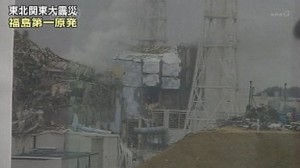
The initial explosion at reactor #4 was said by Tepco, the company that operates the plant, to be caused by machine oil, not hydrogen.
However, if it turns out that #4 was not machine oil, they were hydrogen, that’s a whole ‘nother ball game, indicating criticality may have been reached in the spent fuel pool without Tepco even knowing it.
Is Tepco Lying About The Cause of the Explosions at Reactor #4?
If the initial reactor #4 explosion WAS a hydrogen explosion, and originated with the spent fuel pool there rather than from the reactor itself, then that would (as I understand it) indicate — though absolutely not prove in any way, shape or form — that the spent fuel in the #4 reactor’s spent fuel pool was heating up to the point where the zirconium alloy fuel cladding in the fuel rods was reacting with water to form hydrogen.
That would be hot. Really hot.
A Last Word About How Speculative This All Is
Again, I’m still shocked that anyone’s talking about re-criticality. This still seems really unlikely, borderline impossible. That’s why it’s freaking everyone out that Tepco, which has so thoroughly covered its ass all along, is suggesting not just this extreme scenario, but this way-beyond-extreme scenario.
But then, this crap was in the BBC. This crap was in New Scientist. Tepco has been playing down the crisis from the start. They appear to have vastly underreported the events from early in the process. Now they’re talking about re-criticality in a spent fuel pool. They. Tepco. The nuclear industry.
My speculations sound crazy to many of you, I’m sure. But Tepco’s already blown the roof off of all projections — and everything any of the pro-nuke trolls have said — by saying that the spent fuel can reach re-criticality to begin with. Which, in case you forgot, they already said.
I gather that, to a nuclear engineer, this is a bit like if the Air Force sat all its pilots down one day and said, “We were just messing with you. Those weather balloons really are alien spacecraft.”
Which, quite frankly, I’m half-expecting Tepco to do, any minute.
Back on the 14th, Snopes 
The BBC 


Recent Comments