Archive

Posts Tagged ‘design’

The Birds II: This Time It’s Personal

March 11th, 2011 No comments

Photo from XRailbyRCI.com.

Would you rather carry ammo and have to load it, costing you valuable time, or would you prefer it in your gun?

Of course the answer is always “in my gun.”

My sentiments exactly!

Though a relatively small number of magazine-fed shotguns exist, they’re rare in the civilian market. Most shotguns feed through what’s called a “tube magazine.” It lines the shells up end-to-end between your trigger finger and the muzzle. The magazine is part of the gun. It’s the same overall configuration used in the Henry rifle design so popular in the frontier era (aka the Indian Genocide era), but most civilian shotguns are pump action, as opposed to the lever-action most common in Henry-style rifles (though some rifles, also, are pump action). Even semi-automatic shotguns tend to use tube magazines in the United States, even if they’re military or law-enforcement.

That means that if you’re a shotgun user, you usually can’t use extended magazines like the ones you’ll use to guarantee your second-amendment freedoms in the event that Bubba-Larry starts talking shit over at the bait store about how your AK can’t hit anything. Shotgun magazines (like Henry rifle magazines) are integral to the weapon, and you won’t be able to pull a New York Reload when avian flu morphs into a zombie virus. The day Blackbirdicus ohGoditseatingus starts coming for you en masse, you’re pretty much screwed, zombie-hunter. You ever try to hit a flock of swarming brain-starved featherweights with a pair of Glocks and some Chow Yun Gun Fu? It’s not fun. It’s not fun at all.

Enter Roth Concept Innovations, “designer and manufacturer of high capacity solutions for your shotgun” and the latter-day Tippi Hedren’s very best friend. As a press release in Guns & Ammo informs me, They manufacture the new XRAIL System, “an auto indexing loader for shotguns.”

Here’s what you’ll be wearing, come the apocalypse, to accompany your stylish headgear: Read more…

Tags: , ,

The Miata Makes Sports Car History. The Miata?

February 5th, 2011 3 comments

Courtesy of Mazda USA.

The Mazda MX-5, which is known as the Miata in North America and the Roadster in Japan, is history’s best-selling two-seat sports car. In fact, the 900,000th Miata was just produced, which Mazda touts as a “milestone.” But it’s a strictly numeric milestone, because there’s not really any competition, as far as I can tell. The Miata didn’t actually bust any records by passing 900,000. It blew past the second best-selling two-seater sports car in history, the MG MGB, back at 512,000. The MGB was produced from 1962 to 1980, and retains a fanatic following among vintage car nuts.

Built in Hiroshima (!), the MX-5 was first marketed in 1989 and has spent 20+ years on the market. The secret to its success? It may not be as glamorous as the Ferrari, but it starts at about $23,000 new. In fact, you can put your hands on a used one a few years old for like $16,000 to $18,000.

It has plenty of competitors, including the Honda S2000, the Nison 350Z, the Saturn Sky, the Pontiac Solstice, the Mitsubishi Eclipse, and the Audi TT, all of which are in roughly the same price range (well, the Audi costs a at least a few thousand more).

But the Miata has been around for 20 years, and has remained a strong seller the whole time because of its reported reliability. In maintenance terms, it’s like driving an economy car — but according to its devotees, it drives like a dream and has the “charm of an old British roadster,” which is clearly an allusion to the MGB and its predecessors. MG is a British manufacturer, formerly British Motor Cars and now known as British Leyland Motor Corporation.

People who know anything about old British cars will shudder and possibly twitch at the assertion that the Miata has the charm of an old British roadster. In the first place, in my experience the devotion to the MG and other British cars is very much like an addiction or a disease; the very suggestion that a Japanese-built car would equal the MG in “charm” is, to a devotee, like saying “Here, honey, why not just have some candy for your heroin habit?” “I know you’re a Type II diabetic, but why not wear a crystal around your neck instead of taking insulin?” — that sort of thing.

Which is not to say that the love of British sports cars is incurable — far from it. Old British sports cars may be hugely glamorous in that special way, but they’re also steampunkishly-hard to take care of. People love them and hate them; they demand your obsession like the world’s most beautiful and psychotic chainsaw-wielding dominatrix. Buy an ancient Triumph and you’ll fall in love with a beast sure to break your heart…every six weeks for the time you own it. Eventually, you may stash it in the garage like Edward Rochester’s wife in the attic, or wake up from the love affair and start getting into motorcycles.

But you won’t buy a Miata.

The Miata’s not hard to take care of, from what I hear. It may not have the wonky obsessive devotion of the kind of people who fall in love with old Triumphs — but hell, who has time for that nowadays? Everyone I know who’s ever owned a Miata has described it as a blast to drive and not especially practical, owing to the lack of a back seat. They’ve also taken pot-shots from everyone within and just out of earshot about their “mid-life crisis,” whether they were 25 or 60 when they bought it. But that’s pretty much guaranteed to anyone over the age of 20 who buys a sports car.

If, rejecting the Miata’s easy glamour, you find yourself dead-set on being a purist and going for a Ferrari, this 2006 Forbes Vehicle-of-the-Week article informs me that you can get a used Ferrari Mondial for somewhere between $15,000 and $30,000 — but you’ll likely have your hands full.

So…that’s it. The Miata. The best-selling two-seat sports car in history. Wow.

Tags: ,

Rolling Cities on Rails

January 6th, 2011 No comments

Image courtesy of Jagnafalt Milton, Stockholm.

The Stockholm design firm of Jagnafalt Milton won third place in a competition for new development proposals for the city of Åndalsnes, Norway. They want to put the whole town on rails.

It seems Åndalsnes is an old railway town and a resort town. Jagnafalt Milton believes the existing railway infrastructure can be used to create a city whose buildings are repositioned based on the seasons. According to today’s article on Wired.co.uk:

It proposed designs for rail-mounted single- and double-birth cabins, along with a two-storey suite. It also imagined lookout towers, kitchens, lifeguard stations, changing rooms, and — in true Swedish spirit — a sauna.

The idea, says the agency, was to use the city’s railway infrastructure — left behind from the days when it was an maritime construction town, building oil rigs — as a basis for its future. Konrad Milton, one of the partners in the company, told Wired.co.uk: “As we see it there are two major benefits. First, it’s easier to put buildings on existing train tracks than to demolish the tracks and build regular building foundations. Secondly the city of Åndalsnes has different needs depending on season.”

He continued: “Summertime the city is full of tourists from cruise ships and hikers — during this time there is a need for hotels and shopping. Wintertime the climate is harsh and there is less activity but a need for climate shelters and public indoor activities. By changing the building line-up according to seasons and events the city can become truly flexible.”

[Link.]

Tags: ,

The Holsman High-Wheeler

December 29th, 2010 No comments

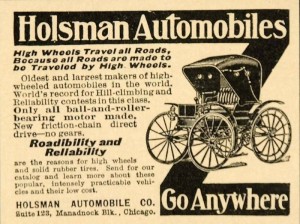
Spotting this vintage 1909 ad for sale on EBay reminded me how much I love the Brass Era of automobile manufacturing, and the Holsman High-Wheeler in particular. If you have the brass, you can put in a bid for it; it’s up for bidding until the middle of January, and the bid at press time is a mere $36.95 — a pittance for a hundred-year-old newspaper ad, right?

The Brass Era is one of the names for the pre-World War I period when cars were fielded with many brass fittings. The Holsman model was part of a class of American cars known as high wheelers that were shaped, more or less, like the earlier horse-drawn buggies. Their high wheels (with solid rubber tires) made it easier to drive over the very rough roads that had been designed for horses, and for horse-drawn carriages with wooden wheels. Many of those tracks still had the ruts left by said wooden wheels.

Controlled by joystick, the Holsman High Wheeler, manufactured by Chicago’s Holsman Automobile Company in Chicago from 1901 to 1910. It was controlled by joystick, rather than wheel, like many old cars. According to HolsmanAutomobile.com, a tribute and resource page for collectors and historians, the motto of the company was “High Wheels Travel All Roads Because All Roads Are Made To Be Traveled By High Wheels.” Holsmans are rare. Of at least one model, the 10K, there is only one example in existence.

Creative Commons image by James Tworow

The Holsman page has some wonderful excerpts from period descriptions of the car. Here’s a sample that helps give you a sense of what it must have been like to operate one of those beauties:

The gasoline tank is placed in the seat back.  Steering is by means of a horizontal lever, similar to those used by many of the electric vehicles.  Throttling is accomplished by twisting the end of the steering handle.  The gear changing is done by means of a small hand lever shifting a short distance along the front of the seat.  A large side lever swings the countershaft to start, stop and reverse the movement of the vehicle in the manner previously explained.  The springs are all full elliptic, and the carriage is claimed to be absolutely vibrationless.  In front of the dash is a compartment, which holds the batteries and furnishes a storage space in addition.  There is also room for storage behind the seat.  The forward mudguards are arranged to swing with the front wheels.  A tool box is arranged under the floor just back of the dash.  The weight is about 900 pounds.  No differential is used, as the belts will slip enough to accomplish the object sought.

…Is it just me? Does that make you long for the glorious stink of mud and cow manure as you race at a breakneck speed of eight miles per hour to stop that scoundrel Dr. Berpopple from tying your fiancee to the train tracks so she can’t inherit the mining concessions from her ill father…or what?

High Wheels Travel All Roads Because All Roads Are Made To Be Traveled By High Wheels.”

Momocreatura Jewelry: Death Becomes Cute Overload

December 29th, 2010 No comments

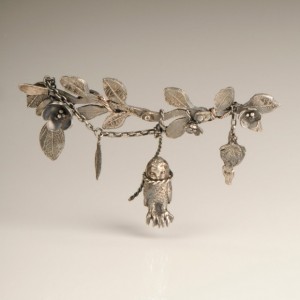
Momocreatura Hanged Owl Pin

It’s certainly true that many of us girlier girls – even those of us with guns and motorcycles – love pretty shiny jewelry. And like, totally cute little animals. But not all girls who love the shiny shiny also love adorable roadkill presented as strange and unsettling macabre bestiary mythology, so perhaps the items from Momocreatura (jewelry design) are for that rare babe who squeals with glee at both LOLcat and puss-oozing zombie alike.

Momocreatura’s fantastical creations are impossibly whimsical and frankly disturbing, which also makes them pretty delightful. In a twisted way. Notably, the Nearly Dead series. Think Alice in Wonderland taxidermy. A Momocreatura brooch boasts little owls dangling by neck from nooses; squirrels made of silver stand stolidly, waiting with axe in hand. Stud earrings are axes and the savaged heads of woodland animals; on a silver chain are strung furry cuties such as bunnies and mice suspended by the holes in their hearts. Cheerful. We love it.

* Facebook: Momocreatura

Counter Space: Design and the Modern Kitchen

October 28th, 2010 No comments

Margarete Schütte-Lihotzky (Austrian, 1897-2000). Frankfurt Kitchen from the Ginnheim-Höhenblick Housing Estate, Frankfurt am Main, Germany (reconstruction). 1926–27. Various materials, 8’9” x 12’10” x 6’10” (266.7 x 391.2 x 208.3 cm). The Museum of Modern Art, New York. Gift of Joan R. Brewster in memory of her Husband George W.W. Brewster, by exchange and the Architecture & Design Purchase Fund. Image courtesy of MoMA.

Counter Space: The Evolution of the Kitchen, running at New York’s Museum of Modern Art through March 2011, chronicles the rise of the kitchen as a defining possession of the twentieth-century Western middle class.

Starting with the iconic post-World-War-I German concept of Grete Schütte-Lihotzky’s “Frankfurt Kitchen,” which “reflected a commitment to transforming the lives of ordinary people on an ambitious scale,” the exhibit shows how kitchens a central part of what defines domesticity:

Previously hidden from view in a basement or annex, the kitchen became a bridgehead of modern thinking in the domestic sphere—a testing ground for new materials, technologies, and power sources, and a spring board for the rational reorganization of space and domestic labor within the home…kitchens have continued to articulate, and at times actively challenge, our relationship to the food we eat, popular attitudes toward the domestic role of women, family life, consumerism, and even political ideology in the case of the celebrated 1959 “Kitchen Debate” that took place between Richard Nixon and Nikita Khrushchev in Moscow at the height of the Cold War.

Featured alongside the Frankfurt Kitchen is a 1969 mobile fold-out unit manufactured by the Italian company Snaidero. These two complete kitchens are complemented by a wide variety of design objects, architectural plans, posters, archival photographs, and selected artworks, all drawn from MoMA’s collection. Prominence is given to the contribution of women throughout the exhibition, not only as the primary consumers and users of the domestic kitchen, but also as reformers, architects, designers, and as artists who have critically addressed kitchen culture and myths.

The exhibit is presented in conjunction with this past summer’s hardcover Modern Women: Women Artists at The Museum of Modern Art. The New York Times and NPR both have interesting reviews of the exhibit.

Counter Space: Design and the Modern Kitchen runs through March 14, 2011 in the Michael H. Dunn Gallery on the second floor of the Museum of Modern Art, 11 West 53rd Street, New York City.

Tags: , ,

Gorgeous Art Deco Henderson Motorcycle

October 18th, 2010 3 comments

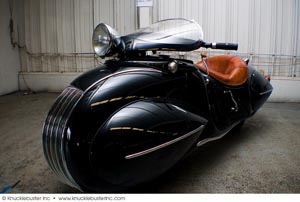
Photo of 1930s Henderson by Grail Mortillaro.

Photo by Grail Mortillaro, KnuckleBusterInc.com.

As you might be able to tell, I get a little worked up over gear and over history sometimes. Every now and then, there’s a piece of equipment I see that combines the two, and just makes me blow a gasket.

This vintage custom bike based on a 1930s Henderson, showcased at Grail Mortillaro’s DIY motorcycle blog KnuckleBusterInc.com, is so many flavors of gorgeous I don’t even know which one to start with. It comes to me via this cat I know who runs the equally awesome cocktail blog 12BottleBar.com.

That this custom motorcycle is a work of art goes without saying. The pictures have to be seen to be believed; pretty much all I can do is stare and drool. Anyone who appreciates vintage motor vehicles, product design, or the art deco period can surely appreciate this bike. Check out said pix at KnuckleBuster, and I’ll quote Mortillaro on a few of the deets:

I took these photos at the Rhinebeck Grand National Meet where the newly restored bike was unveiled. The bike belongs to Frank Westfall from Syracuse, NY. According to some info I found online, the bike was originally built by O. Ray Courtney in 1936 and is based on a 1930 K.J Henderson. The bike is powered by inline four cylinder (not a scooter as some have said, check the shot of the motor below) and as I’m sure you can gather by now, is a one-off custom.

Mortillaro continues:

…The bike is a fantastic piece of history, the craftsmanship is absolutely stunning and it’s surely more of a museum piece than a daily rider.

I couldn’t have said it better myself. What even possesses a human to create something like this? Same kinda demon that possessed Michelangelo, Hildegard Von Bingen, Jimi Hendrix, Sylvia Plath — only with more horsepower and a torque wrench. Not to, you know, put too fine a point on it or anything.

The Henderson that Mr. Mortillaro refers to is the Henderson motorcycle built from 1912 to 1931; Wikipedia informs me Henderson motorcycles were the biggest and fastest motorcycles of their day, favored by police because of their obvious utility in pursuit. The KJs were late model Henderson, and a thriving restoration community exists today.

There are more pics of the bike at KnuckleBusterInc.com.

Tags: , ,

Researchers Developing Robot Chair

September 21st, 2010 No comments

Photo by Brianne Bowen

Photo by Brianne Bowen, Yale Daily News.

…working on robot World of Warcraft legend to sit in it and pwn all your asses. Actually, what the robot lab at Yale is working on at Yale is really more like a robot Sister Mary Katherine SitUpStraight, complete with vibrating ruler.

But seriously, folks: the student newspaper at Quinnipiac University in Connecticut informs me that the robotics department at Yale is working on a robotic chair that zaps you when your posture goes South:

The department has taken a simple office chair and placed sensing resistors at four different spots where pressure is highest when sitting in proper posture. When the sitter’s posture shifts out of the ideal position, the chair vibrates as a reminder to sit up straight. Depending on the sensors, different parts of the chair will vibrate.

Yale engineering and applied science professor John Morrell and [industrial design] graduate student Ying Zheng…decided to take a regular office chair with a mesh back and tweaked it, applying various sensors to it to create the posture alert chair that is in works at the Yale Human Machine Interface Laboratory.

The Yale Daily News reported this back in April when said Nun Chair was presented at the 2010 Haptics Symposium, but it’s HermanMiller.com that probably got most excited about this development, since Morrell et al started their project with a Herman Miller Aeron Chair — yes, the same damn ones you hear about constantly if you listen to San Francisco’s KQED, where they tell you to pop over to Sit4Less.com and order that puppy in the new color, “True Black,” whatever the hell that’s supposed to mean.

Then if you want to play ball like the Yale kids, you break out about a dozen Hitachi Magic Wands and rig their switches to your back, neck, elbows, knees and tookus with some crochet yarn and duct tape, and…

Look, I’d continue — but when you’ve got a pedigree like mine, you just don’t crack wise about things that vibrate.

Japan’s Secret Hanging Chamber

August 27th, 2010 3 comments

Japan's Execution Chamber Image Mainichi Daily News

Image: Mainichi Shimbun.

Japan is one of the few industrialized nations that still uses the death penalty, and they still execute prisoners by hanging. Mainichi Shimbun (or “The Mainichi Daily News,” one of Japan’s largest newspapers) says that reporters were allowed to view Tokyo’s execution chamber, one of the seven such facilities in the country, for the first time today.

The sterile-looking chamber has a trap door in the floor, with a room below into which the hanging condemned fall so they are not visible to observers as they die. Reporters did not see that chamber.

Keiko Chiba, Japan’s Justice Minister, decided to show the room to reporters after witnessing the execution of two prisoners. She said she wanted to spur a nationwide debate on whether the death penalty should exist in Japan and how executions should be performed.

Hanging is specified in the Japanese Penal Code as the method by which executions shall be performed, a practice that dates to the Meiji period (1868-1912).

Extreme (But Real) Ads From the “Mad Men” Era

August 3rd, 2010 No comments

If you watch the TV series Mad Men, then you’re already awash in the great outfits, intense over-consumption, crisp eroticism, and unsettlingly confrontational commonality of misogyny and racism. Website Bored Panda put together this collection of vintage advertisements that would be banned today, and many of them clearly would hail from Sterling Cooper’s desks — even a few of the show’s “clients” are in the roundup. Warning: this collection of (real) ads contains something to offend everyone, from the ads about when it’s “okay” to kill a woman to bleaching skin color to appear ‘more white,’ levied only by the ads explaining which cigarettes doctors prefer most. (boredpanda.com)